


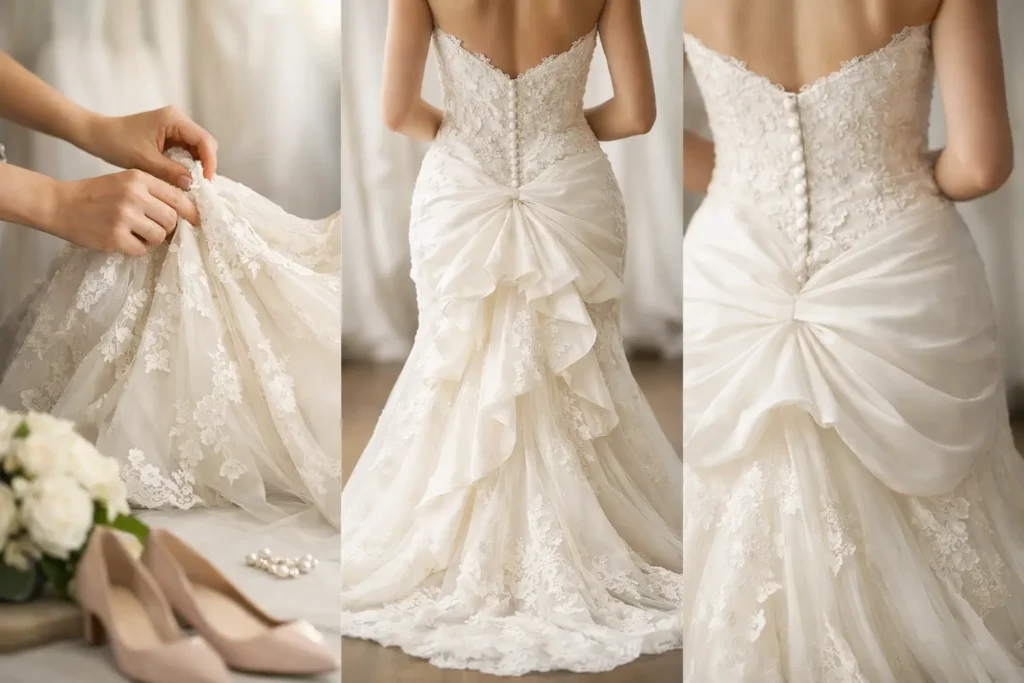
Wedding Gown Bustle Options Explained
The moment your ceremony ends, your dress has to do a different job. A long train looks beautiful walking down the aisle, but once it is time to move, greet guests and dance, it needs to be lifted properly. That is where wedding gown bustle options matter. The right bustle keeps your gown elegant, comfortable and secure without changing the look of the dress more than necessary.
A bustle is not one-size-fits-all. The best choice depends on your gown’s fabric, train length, silhouette and how much movement you want at the reception. It also depends on whether you prefer the bustle to disappear into the design or become part of it. A good tailor or bridal alterations specialist will assess all of those details before recommending the right finish.
What a bustle needs to do
At its simplest, a bustle lifts the train off the floor after the ceremony. In practice, it also needs to distribute weight well, sit neatly against the gown and hold up through hours of walking, hugging, photos and dancing. If the attachment points are placed poorly, even a beautiful gown can start to pull, sag or twist.
This is why bustle work is more technical than many brides expect. Delicate lace, beadwork, tulle and satin all behave differently. A lightweight train may only need a few well-placed attachment points, while a heavier gown may need more structure to avoid strain on the fabric.
The main wedding gown bustle options
There are several established bustle styles, but most brides will choose from a small group of practical favourites.
American bustle
The American bustle, sometimes called an over-bustle, gathers the train up and fastens it to the outside of the gown. The train lifts and drapes over the back of the dress, usually with buttons, hooks or ribbons placed near the waist or lower back.
This is one of the most popular options because it is versatile and often suits A-line, ball gown and some fit-and-flare dresses. It can create a soft, flattering shape and usually works well when the gown has decorative detailing on the train that you still want partly visible.
The trade-off is that it becomes part of the dress’s visual design at the back. If you want the bustle to be almost invisible, this may not be your first choice.
French bustle
The French bustle, also called an under-bustle, tucks the train underneath itself. Instead of draping over the outside, the train is lifted from beneath and secured inside the gown, creating soft folds under the back of the skirt.
This style is often a strong choice for gowns with a more formal or structured look. It can feel a little more hidden than an American bustle and gives the back of the dress a tidy, sculpted finish. Many brides like it on trumpet or fit-and-flare silhouettes because it can preserve the line of the gown well.
The catch is that it may need more internal attachment points, especially on a heavier train. If the gown is very full, it can also add volume at the back, which some brides love and others do not.
Ballroom bustle
A ballroom bustle is designed to make the train disappear almost completely. Once fastened, the gown looks more like it was made without a train at all. This can be ideal if you want a clean reception look without obvious draping or folds.
It tends to suit fuller skirts and formal gowns, but it requires careful planning and enough internal structure to support the fabric properly. On the right dress, it looks polished and elegant. On the wrong one, it can feel bulky or too engineered.
Austrian bustle
The Austrian bustle creates a gathered effect using one or more vertical points. It draws the fabric up in a ruched line and can create a soft, romantic shape down the back of the dress.
This is less common than American or French styles, but it can be beautiful on gowns with lighter fabrics or a design that suits a central gathered detail. It is more style-specific than universal, so it depends heavily on the dress.
Wrist loop or train loop
A wrist loop is the simplest option. Instead of fastening the train up onto the dress, a loop allows the bride to carry the train on her wrist. This can work for very short trains or for a brief period during photos.
It is not usually the best long reception solution. Holding part of your dress all night becomes tiring, and the train can still drag or swing awkwardly. It is better treated as a backup or secondary option than a full bustle replacement.
How to choose between wedding gown bustle options
The right bustle starts with the dress itself. A large satin ball gown handles weight differently from a lace sheath or layered tulle gown. Fabric matters because some materials show stitching or tension more easily, while others can conceal hooks and ribbons better.
Train length also plays a big role. A sweep train may need only a minimal lift, while a chapel or cathedral train often needs a more structured approach. The longer and heavier the train, the more important it is to spread the load across multiple points rather than relying on one fastening.
Your reception plans matter as well. If you want to dance properly, move freely between tables and stay in the gown for hours, the bustle has to be secure and practical. If you are changing into a second outfit soon after formalities, you may prefer the simplest tidy solution rather than the most elaborate one.
Personal taste should not be underestimated either. Some brides are happy for the bustle to become a visible design feature. Others want it to disappear as much as possible. Neither approach is wrong, but it should be discussed before alterations begin.
What happens at a bustle fitting
A bustle fitting is not just about pinning fabric up at the last minute. It should happen as part of your wedding alterations, once the hem, fit and overall shape of the gown are being finalised. That timing matters because changing the hem or silhouette can affect where the bustle should sit.
During the fitting, the tailor will look at the train’s weight, the gown’s construction and how the fabric falls when lifted. Different bustle styles may be tested so you can see how the back of the dress changes. This is often the moment brides realise their original idea looks different in real life than it did in photos online.
You should also practise how the bustle is fastened. On the wedding day, it is usually a bridesmaid, family member or coordinator doing it, not the person who altered the dress. If the system is overly complicated, it can become stressful very quickly. Clear labelling, simple attachment points and a quick demonstration can make a big difference.
Common bustle mistakes to avoid
One of the biggest mistakes is leaving bustle decisions too late. If the gown needs detailed alteration work, the bustle should be planned with the rest of it, not added as an afterthought. Rushing increases the chance of poor placement or a style that does not suit the gown.
Another common issue is choosing based on trend rather than function. A bustle may look lovely standing still, but if it shifts after ten minutes of movement, that beauty does not help much. Strength, balance and comfort matter just as much as appearance.
It is also worth thinking about the people helping you on the day. Tiny hidden loops and hard-to-find hooks can look neat at a fitting, but they are less charming when someone is trying to fasten them in a busy change room with limited time.
When expert alterations make the difference
Bustle work sits at the intersection of fit, construction and finish. It needs a practical eye as well as a careful hand. On heavily embellished gowns, the attachment points have to work around lace motifs, boning, lining and weight distribution. On simpler gowns, every detail is more visible, so clean workmanship matters even more.
That is why bridal alterations should feel collaborative. You need honest advice about what will work on your gown, not just a standard answer. An experienced alterations specialist can explain the pros and cons clearly, show you how the bustle changes the silhouette and make sure the final result supports the way you actually plan to wear the dress.
For brides in Melbourne, working with a trusted local tailor such as AD Stitch can make that process far less stressful. A proper fitting, clear guidance and precise finishing give you one less thing to worry about on the day.
The best bustle is the one that lets you stop thinking about your train altogether. When it is done properly, your gown still feels like your gown – just easier to move in, easier to enjoy, and ready for the second half of the celebration.