


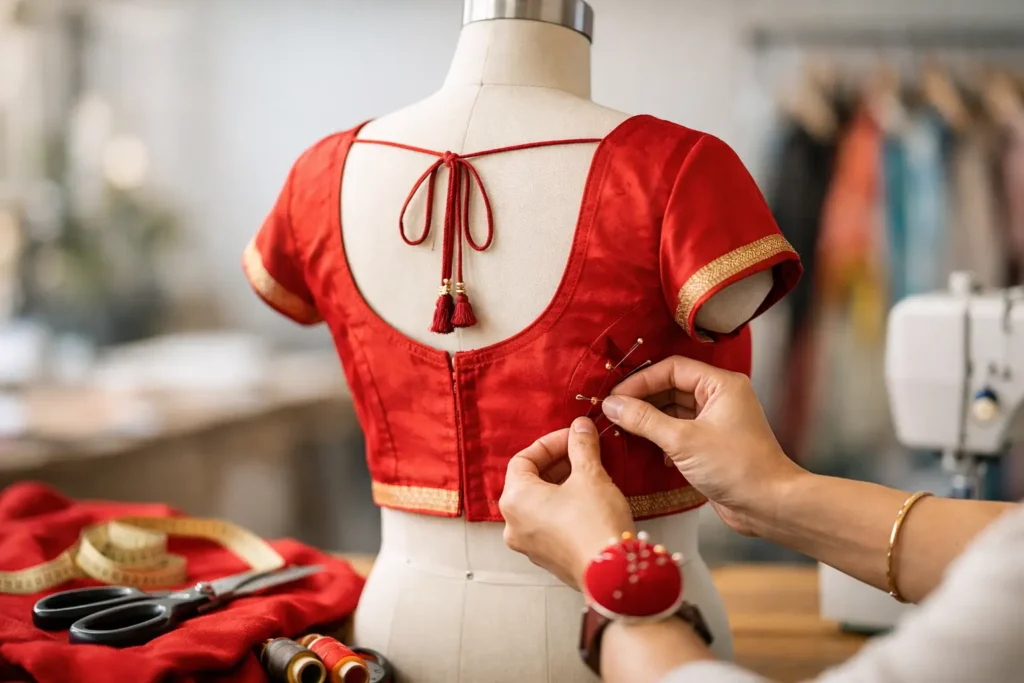
How to Resize a Saree Blouse Properly
A saree blouse can look almost right on the hanger and still feel wrong the moment you put it on. Maybe it pinches at the bust, gapes at the neckline, cuts into the armhole or sits loose through the back. If you are wondering how to resize a saree blouse, the good news is that many fit issues can be corrected – but the best result depends on the blouse’s construction, seam allowance and fabric.
Unlike a simple top, a saree blouse is a fitted garment that needs to balance shape, support and comfort. A small adjustment can make a major difference to how the whole saree sits and how confident you feel wearing it. That is why resizing needs a careful eye, especially with lined fabrics, embellished work, piping, cups or delicate closures.
How to resize a saree blouse without ruining the fit
The first step is identifying exactly what is wrong. “Too tight” is not always one problem. A blouse may be too snug across the bust but fine at the waist. It may feel restrictive because the armhole is too high, not because the body is too small. It may gap at the front because the shoulder length is off. Good resizing starts with diagnosis, not guesswork.
In most cases, a tailor will assess the blouse while it is being worn. This matters because saree blouses are close-fitting and often shaped to the body with darts, princess seams or curved side seams. Looking at the garment flat on a table rarely tells the full story. The way it pulls, wrinkles or lifts on the body shows where the issue starts.
If the blouse needs to be made smaller, the process is usually more straightforward. Excess fabric can often be taken in through the side seams, back seams or darts. The challenge is keeping the shape balanced so the neckline, sleeve and hem still sit neatly. Taking in too much from one place can throw off the proportions.
If the blouse needs to be made larger, the answer is more variable. This depends on whether there is enough seam allowance inside the blouse to let it out. Many blouses are stitched with extra margin for future adjustments, but not all are. Ready-made blouses, heavily overlocked seams and very fitted designs sometimes leave little room to expand.
Common saree blouse alterations
A resize is rarely just one change. Often, a better fit comes from a combination of smaller corrections.
Taking in the sides is one of the most common alterations. This works well when the blouse feels generally loose through the bust and waist. If the blouse is loose only at the back, adjusting the back seam or adding shaping there may be a better option.
Letting out the seams can help when a blouse feels tight, especially after body changes or when an older blouse is being worn again for a wedding, family function or festival. The result depends on how much hidden fabric is available and whether any trims or embellishments sit close to the seam line.
Shoulder adjustments are another important area. If the shoulder is too wide, the neckline may gape and the sleeve may collapse. If it is too narrow, the blouse can pull upward and feel restrictive. This is a more technical change because it affects the armhole and sleeve position.
Bust shaping may also need attention. Darts can sometimes be repositioned or refined to improve contour and support. This is particularly useful when the blouse technically closes but does not sit smoothly.
Sleeves can be resized too. If they are too tight around the arm, there may be scope to let them out, depending on the seam allowance. If they are too loose or too long, they can be reduced for a cleaner silhouette.
What makes a saree blouse harder to alter
Some blouses are quite forgiving. Others require much more precision.
Padded blouses need extra care because the cups must still align with your shape after alteration. If the cups shift out of position, the blouse may fit worse even if the measurements look right. Lined blouses also take more time because both the outer fabric and lining need to be adjusted cleanly.
Embellished and embroidered blouses can be more limited. Beading, zari work, sequins and borders may sit across the seam area, which restricts how much can be taken in or let out. In some cases, the alteration is still possible, but it needs slower, more careful handling to preserve the finish.
Back styles matter as well. A blouse with hooks, tie-backs, deep backs or cut-out designs often has less room for simple adjustment. The fit has to remain secure while also sitting evenly. Even a small asymmetry at the back can become very noticeable.
Fabric is another factor. Silk blends, brocade, velvet and stretch materials all behave differently under the needle. Some mark easily, some fray, and some show every old stitch line once unpicked. That is why a resize should never be treated as a basic quick fix.
Can you resize a saree blouse at home?
If the blouse is inexpensive, plain, and only slightly loose, a confident home sewer may be able to manage a minor adjustment. Taking in a little at the side seams can be possible if you understand garment balance and can pin the blouse accurately on the body.
But most saree blouses are not ideal beginner projects. The seams are curved, the fit is close, and the margin for error is small. One crooked line can distort the bust, twist the side seam or make the neckline sit unevenly. Unpicking and redoing can also leave visible marks, especially on delicate fabrics.
For a blouse with lining, padding, handwork or sentimental value, professional alteration is the safer option. A well-fitted saree blouse should feel secure but not tight, shaped but not strained. Getting to that point usually takes more than a quick stitch along the edge.
How to prepare for a saree blouse fitting
Bring the saree you plan to wear with the blouse if possible, or at least wear similar undergarments to the fitting. The drape of the saree and the support underneath can affect how the blouse sits on the body.
It also helps to explain how you want it to feel. Some clients prefer a very close, structured fit. Others want a little extra ease for comfort, especially if they will be wearing the outfit for hours at a wedding or event. Neither is wrong, but the finishing measurements should reflect how you actually plan to wear it.
If there is any issue that bothers you now, mention it clearly. Perhaps the armhole rubs, the neckline feels too low, or the hooks strain when sitting down. These details help guide the alteration and avoid a result that looks good on the stand but still feels off in real life.
How to resize a saree blouse for the best result
The best approach is to alter only what the blouse needs, not chase a perfect number on a tape measure. A blouse can measure correctly and still sit poorly if the shape is wrong. Fit is visual and practical, not just technical.
A careful tailor will check proportion across the shoulder, bust, waist and back rather than focusing on one seam. They will also consider whether the blouse has enough internal allowance to be enlarged and whether the design supports the change you want. Sometimes the right advice is yes, this can be done neatly. Sometimes it is that the blouse can be improved, but only to a point.
That honesty matters. Over-altering a blouse can create stress lines, misaligned embellishments or awkward shaping. A good result is one that looks natural, feels comfortable and preserves the original style of the garment.
For customers wanting expert clothing alterations, a proper fitting and skilled workmanship make all the difference. At AD Stitch, we often see garments that only need a precise adjustment to become wearable again. That is especially true for occasionwear, where comfort and confidence matter just as much as appearance.
A saree blouse should support the outfit, not distract from it. If it is sitting too loose, too tight or just not quite right, resizing can often restore both the fit and the finish. The smartest move is to treat it as a tailored garment, because that is exactly what it is.
The right alteration does not just change measurements – it changes how you carry the whole outfit.