


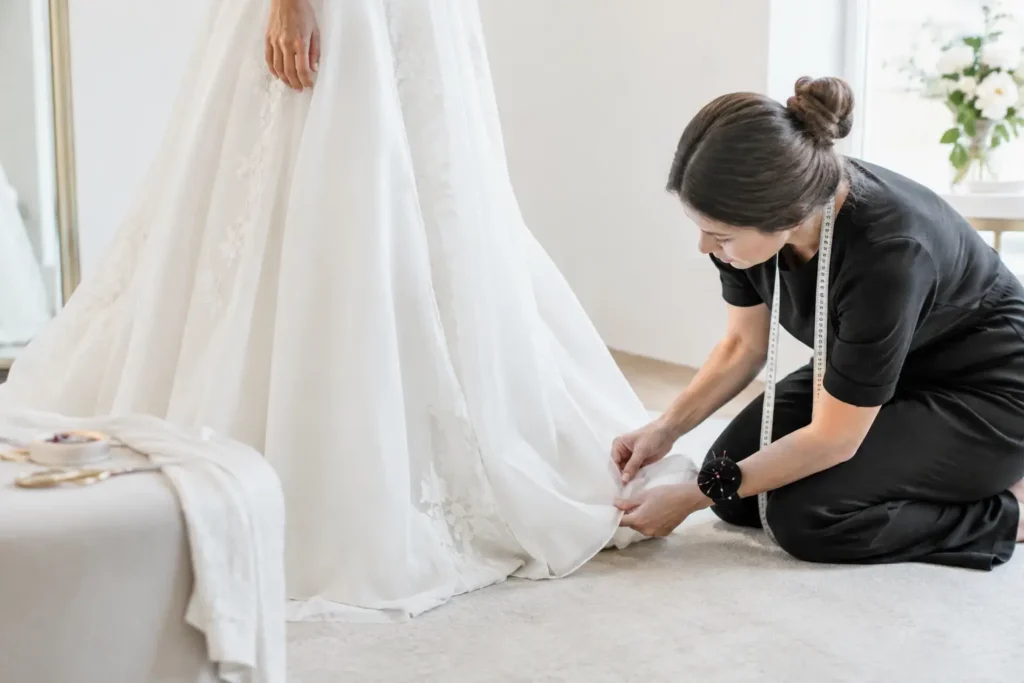
Wedding Dress Hemming: What to Know Before Fitting
A wedding dress can look perfect on the hanger and still feel unfinished once you put it on. The hem is often the detail that changes everything: it affects how the gown moves, whether you can walk confidently, and how polished it looks in photographs. For wedding dress hemming: what to know starts with one simple principle – the right length is not always the shortest length. It is the length that works with your shoes, venue, fabric and the way you want to move through the day.
A professionally hemmed gown should let you walk, turn and dance without constantly lifting the skirt, while still preserving the design and fall of the dress. That balance takes careful measuring, experienced handling and enough time for fittings.
Why the hem matters more than most brides expect
Your wedding dress hem sits close to the floor, so even a small error is noticeable. If it is too long, you may catch the fabric under your heel, step on the train or collect dirt as you move between the ceremony and reception. A hem that is too short can make the gown look as though it was altered in a hurry, particularly with a full skirt or formal silhouette.
Length also affects proportion. The hemline helps determine where the eye lands, how the skirt falls from the waist, and whether the dress looks balanced with your footwear. This is especially true for gowns with lace edging, layered tulle, beading or a dramatic train. A good alteration respects the original construction rather than treating the bottom of the dress as a straight line to cut.
When to book wedding dress hemming
Ideally, arrange your first alteration fitting around two to three months before the wedding. This gives your tailor time to assess the dress, complete the hemming carefully and make any related adjustments such as taking in the bodice, shortening straps or adding a bustle. It also leaves room for a final check closer to the date.
That timing can vary. A simple crepe or satin gown may need less lead time than a heavily beaded dress with multiple layers, hand-applied lace or a detailed scalloped edge. If you have ordered a made-to-measure gown, wait until it arrives before making firm alteration plans. The final fit can differ from the sample you tried in store.
Avoid leaving hemming until the last week if possible. While an experienced local tailor can often help with urgent work, rushed alterations limit your options and add unnecessary pressure during an already busy time. Booking early means the work can be completed with precision, not compromise.
Bring the shoes you will actually wear
Your shoe height directly determines the correct hem length. Bring the exact wedding shoes to every fitting, including any inserts or heel grips you plan to use. Even a small difference in heel height can change where the gown sits.
If you are still deciding between shoes, choose them before the hem is marked. Altering the dress for high heels and switching to flats on the day can leave the skirt dragging. If you expect to change into lower shoes for the reception, discuss this at the fitting. In many cases, the dress is hemmed for the ceremony shoes, and a bustle or considered styling helps manage the extra length later.
Also wear suitable underwear or shapewear to your appointment. The support and shape beneath the gown can affect its position on your body, which in turn affects the hem.
How a professional hem fitting works
At a fitting, the dress is pinned while you stand naturally in your wedding shoes. Your tailor will check the length from several angles, not just the front. You may be asked to walk, take a few steps backwards and turn around so the movement of the skirt can be assessed.
The ideal clearance depends on the design. Many gowns sit just above the floor at the front, allowing the toe of the shoe to appear as you walk. The sides and back may be slightly longer to maintain a graceful line. A dress with a train is treated differently again: the front and side hem are adjusted for walking, while the train length is generally preserved unless you specifically want it shortened.
This is also the time to speak openly about your plans. Will you walk on grass or gravel? Are you having a beach ceremony? Do you want to dance freely all night? Will you be moving between indoor and outdoor locations? These details help determine a practical finish without losing the look you chose the gown for.
Different fabrics need different hemming methods
Wedding gowns are rarely simple single-layer garments. The visible outer layer may be silk, satin, chiffon, crepe, tulle or lace, with lining, crinoline and underskirts beneath. Each material handles differently, and the hemming method should suit the fabric and construction.
A clean satin or crepe gown can often be shortened with a finely finished hem that keeps the line crisp. Chiffon requires a lighter touch because it can shift easily and reveal unevenness. Tulle is commonly adjusted layer by layer, with each layer assessed for length and volume. A gown with horsehair braid at the edge may need the trim removed and carefully reapplied to retain its structured wave.
Lace and beaded hems need the greatest care. If the dress has a scalloped lace border, simply cutting the fabric would remove the very feature that gives the gown its finish. The lace may need to be lifted, repositioned and hand-sewn after the underlying layers have been shortened. Beading can add weight and complexity, so the work takes longer and should be planned well ahead.
For this reason, hemming costs and turnaround times vary widely. A quote should reflect the layers, fabric, detail and labour involved, rather than a one-price approach for every gown.
Do you need a bustle as well as hemming?
If your gown has a train, a bustle is usually worth considering. A bustle lifts and secures the train after the ceremony, making it easier to walk, mingle and dance without someone holding your skirt all evening. It does not replace hemming, but it works alongside it.
There are several bustle styles, and the most suitable option depends on the gown’s shape, train length and fabric. Some create folds that sit over the skirt, while others draw sections underneath for a softer result. The goal is to make the train manageable while keeping the back of the dress looking intentional.
Ask your tailor to show a trusted friend, family member or member of your bridal party how the bustle works. Take a short video on your mobile during the final fitting, and practise once before the wedding. Small hooks, loops and buttons are easy to manage when you know the order, but less so in a busy reception bathroom.
Common wedding dress hemming mistakes to avoid
The first mistake is wearing different shoes at the fitting and on the day. The second is standing unnaturally still while the hem is pinned. Stand as you normally would, with your weight balanced, because posture changes the way a dress falls.
Another common issue is assuming every layer should be the same length. Often, the lining and underskirts are intentionally shorter than the outer layer to support its shape without showing. An experienced tailor will preserve those relationships rather than making every layer identical.
It is also wise not to trim a gown yourself, even if it looks like a straightforward job. Wedding fabrics can fray, stretch or show needle marks, and an uneven hem becomes obvious under event lighting and in photographs. The same applies to temporary tape fixes. They may be useful for a minor emergency, but they are not a reliable solution for a formal gown with weight and movement.
Questions to ask at your fitting
Before the work begins, make sure you understand what is being altered and why. Ask whether the gown has multiple layers, whether the lace or trim will need to be removed and reapplied, and whether a bustle is recommended. Confirm when the dress will be ready and arrange a final fitting before taking it home.
At the final fitting, walk in the dress properly. Sit down, take a few steps, practise a turn and check that the front hem clears the floor without looking too high. If the gown feels difficult to move in, say so then. A wedding dress should feel special, but it should never leave you worried about every step.
For Melbourne brides who want attentive, expert clothing alterations, AD Stitch can assess the construction of your gown and tailor the hem to suit your shoes, venue and plans for the day. Careful finishing protects the detail you fell in love with while giving you the freedom to enjoy wearing it.
The best hem is the one you stop thinking about. Once it is fitted correctly, you can walk down the aisle, greet your guests and step onto the dance floor with your attention exactly where it belongs.