


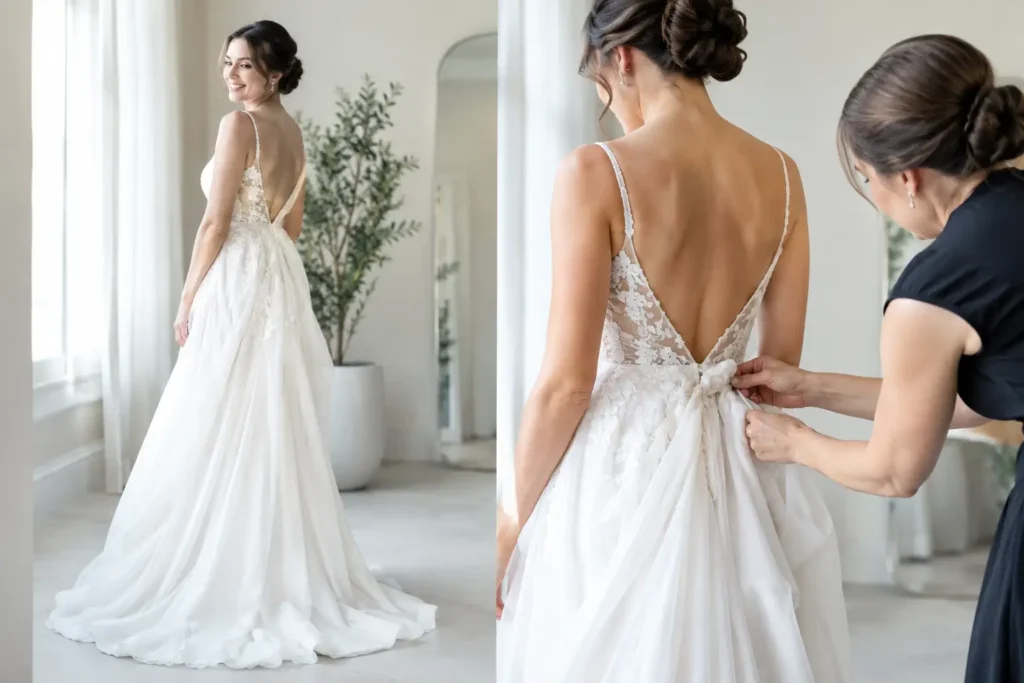
Wedding Dress Bustle: Do You Really Need One?
The aisle moment is over, photos are underway, and now you want to greet your guests, sit down for dinner and dance without carrying metres of skirt over your arm. That is where the question, “wedding dress bustle: do you need one?” becomes very practical. A bustle lifts and secures the train of a gown after the ceremony, helping you move comfortably while protecting the dress from shoes, spills and the dance floor.
A bustle is not essential for every bride or every gown. But for many wedding dresses with a train, it is one of the alterations that makes the difference between simply wearing a beautiful dress and being able to enjoy the whole celebration in it.
Wedding dress bustle: do you need one?
You will probably benefit from a bustle if your dress has a train that reaches the floor or trails behind you. Even a modest sweep train can be stepped on in a crowded reception space, caught under a chair, or marked by outdoor paths and dance floors. A bustle brings that fabric up to a practical length, usually around the back of the skirt, so the hem is less exposed once the formal part of the day is finished.
If your gown is tea length, ankle length or naturally clear of the floor, a bustle is unlikely to be necessary. The same may apply to a fitted gown with only a very short train, particularly if you are having a small, relaxed celebration where dancing and movement are limited. Your dressmaker can assess this properly when you are standing in the gown with your wedding shoes on.
The key question is not whether bustles are traditional. It is whether the train will get in your way after the ceremony. Consider your venue, how much dancing you plan to do, whether you will be walking outdoors, and how heavy the skirt feels when you move. A long satin train at a garden wedding has different needs to a light chiffon gown at a seated restaurant reception.
What a bustle actually does
A bustle is a series of discreet buttons, loops, ribbons, hooks or ties added to the gown. These attachment points gather the train and hold it up after the ceremony. When done well, the finished shape looks intentional rather than bunched or uneven.
The right bustle needs to support the weight of the train without pulling on delicate fabric or distorting the silhouette of the dress. It also needs to be manageable for the person helping you on the day. Most brides choose a bridesmaid, family member or trusted friend to learn the process at their final fitting.
This is why a bustle is more than a quick pin-up job. The placement of every fastening matters. The bustle must work with the dress construction, lining, seams, lace pattern and the way the skirt falls naturally.
Common bustle styles and when they suit
There is no single best bustle. The right style is determined by the fabric, shape and weight of your gown, as well as the look you want once the train is lifted.
Over-bustle or American bustle
An over-bustle lifts the train upwards and secures it over the outer skirt. It can create soft folds and a gathered effect at the back of the gown. This is often a lovely option for dresses with a fuller skirt, layered tulle or romantic detailing, as the gathering becomes part of the design.
The trade-off is that the bustle will be visible as part of the dress shape. With the right placement, this can look elegant and balanced, but it is not designed to disappear completely.
Under-bustle or French bustle
An under-bustle tucks the train underneath the dress, creating a neater effect from the outside. It can suit gowns where you want to preserve a clean back line, especially sleek crepe, satin or fitted styles.
Because the ties and loops sit underneath, this style can take a little more care to fasten. It may also need several attachment points for a long or heavy train. A well-organised helper and a quick practice at the fitting make all the difference.
Ballroom bustle
A ballroom bustle draws up the train so the gown appears to have no train at all. It is particularly useful for ballgown silhouettes or dresses with broad, full skirts, where you want the reception look to remain even and formal.
This option can involve more work because the fabric needs to be lifted at several points to keep the hem level. It is often worth considering when the gown has substantial volume and you do not want a central gathered bustle at the back.
Austrian bustle
An Austrian bustle uses a drawstring-style mechanism to gather the centre back of the train vertically. It can work beautifully on lighter gowns with simple lines, creating a soft, ruched effect. It is less suitable for every fabric and silhouette, so it should be selected only after the dress has been assessed in person.
Fabric, weight and detail matter
A bustle that works beautifully on lightweight chiffon may not provide enough support for a heavily beaded gown. Likewise, a simple crepe dress may show every change in the fabric line, while layered tulle can disguise multiple bustle points more easily.
Lace requires careful planning so loops and buttons do not interrupt the pattern unnecessarily. Beading and appliqué need particular care, both to protect the embellishment and to ensure the added strain is carried by strong internal areas of the gown. Dresses with a cathedral-length train may need multiple points of support rather than one central fastening.
This is where professional wedding alterations are valuable. The aim is not only to make the train shorter for the evening. It is to preserve the dress’s proportions and finish while making it reliable enough for real movement.
When should you decide on a bustle?
Ideally, raise the subject at your first alteration appointment. The final choice is often confirmed once your hem has been adjusted, because the bustle needs to work with the finished length of the dress and the height of your shoes.
Do not leave it until the last few days before the wedding. A bustle can require careful hand work, especially on gowns with layers, lace, detailed backs or a heavy train. Allowing time also gives you the chance to practise fastening it with the person who will help on the day.
At your final fitting, wear your wedding shoes and any shapewear or underskirt you plan to use. Walk, turn, sit and take a few dance steps. Your tailor can check that the bustle sits evenly and that you can move without feeling restricted. It is also sensible to take a short video of the fastening process on your mobile, as wedding mornings can be busy and details are easy to forget.
Can you skip the bustle and use a wrist loop?
Some gowns have a wrist loop or can have one added. This lets you carry the train in your hand while walking. It can be useful for brief moments, such as moving between photo locations, but it is rarely a comfortable all-evening solution.
Holding a train means one hand is occupied, and the fabric can still drag or twist when you dance. A wrist loop may be enough for a very light, short train or a bride who wants to keep the full train visible for most of the reception. For longer trains, it is best seen as a backup rather than a replacement for a bustle.
Avoid a last-minute DIY fix
Safety pins, improvised clips and makeshift ties can damage fabric, catch on lace and come loose at the worst possible time. They may also pull the train into an unflattering shape or place pressure on a delicate seam.
A professionally fitted bustle is designed around your particular gown. At AD Stitch, careful wedding dress alterations focus on both the visual finish and the practical comfort you need to enjoy your day. Bring the dress, shoes and any relevant accessories to your fitting, and ask to see how the train will look before and after it is bustled.
Your wedding gown should still feel like your gown after the ceremony, just easier to move in. If the train is likely to hold you back, a well-made bustle gives you the freedom to celebrate without constantly looking over your shoulder.