


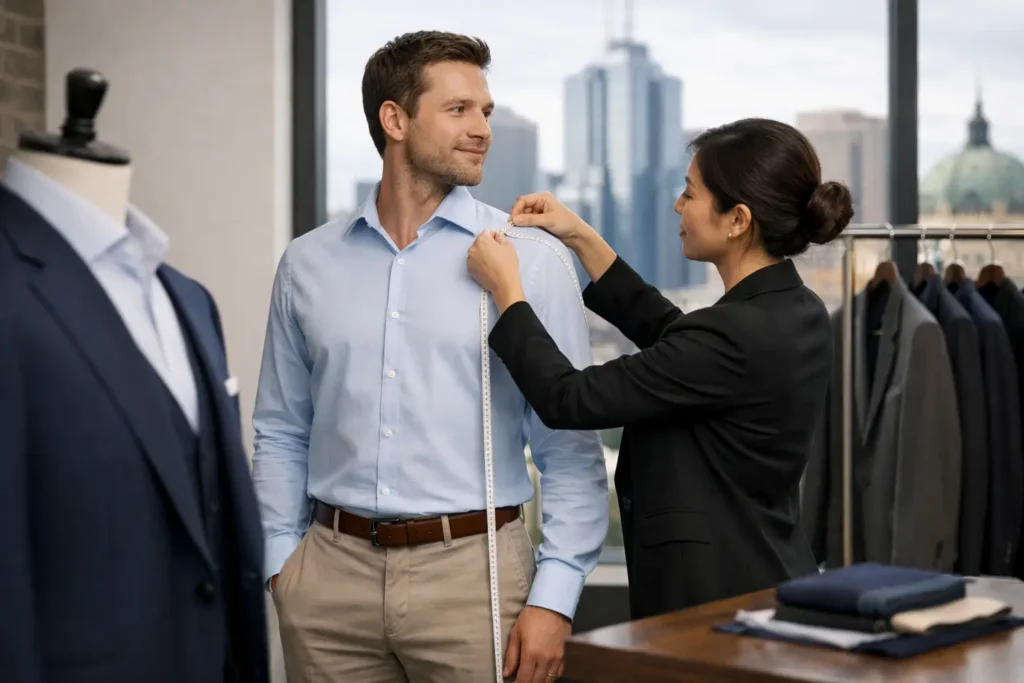
Measurement Service for Overseas Tailoring in Melbourne
Ordering a suit, dress or traditional garment from an overseas tailor can offer excellent fabric choices and personal design options. But before a single stitch is sewn, the measurements must be right. A professional measurement service for overseas tailoring in Melbourne gives your tailor a reliable starting point, while helping you understand exactly what is being recorded and why.
A measuring tape alone is not the answer. Good fit comes from accurate body measurements, careful posture checks, garment preferences and clear communication with the maker. This is particularly important when the person taking your measurements is in Melbourne and the person cutting the garment is on the other side of the world.
Why professional measurements make a difference
Overseas tailoring often works through photographs, messaging apps, order forms and detailed specification sheets. There is no opportunity for the tailor to see how you stand, where a jacket pulls across the back or how much room you prefer through the seat of your trousers. The measurements become the conversation between you and the maker.
A professional tailor measures more than circumference. They look at shoulder slope, posture, balance, body proportions and the way you want the finished garment to sit. For a suit, that may include natural waist position, sleeve pitch, jacket length, trouser rise and the break over your shoes. For a fitted dress, it may mean checking bust position, torso length, hip shape and the amount of movement needed to sit comfortably.
This level of care reduces guesswork. It does not guarantee that every overseas garment will need no adjustment at all, because cutting methods and fit standards vary between tailors. It does, however, give the maker a far stronger set of information than self-measurements taken in a mirror.
What a measurement service for overseas tailoring in Melbourne includes
The right appointment should be built around the garment you are ordering, not a one-size-fits-all list of numbers. A wedding outfit, business suit, saree blouse and winter overcoat each need a different approach.
For most tailored garments, the service begins with a conversation about the order. Bring the overseas tailor’s measurement form, message thread or measurement guide if you have one. Some makers ask for specific points that are not part of a standard alteration fitting, such as nape-to-waist length, bicep circumference, front chest width or trouser outseam. Seeing their requirements beforehand helps ensure nothing is missed.
The measuring process should also cover your intended fit. Do you like a close, contemporary suit or a more traditional, comfortable cut? Will you wear the garment over a shirt, knitwear or shapewear? Are the trousers for office wear, dancing at a wedding or everyday use? A number on a chart does not explain these preferences, but they affect the ease the overseas tailor needs to build into the garment.
You should leave with measurements recorded clearly, usually in centimetres, and labelled in a way that matches the maker’s form. Clear presentation matters. A perfectly taken chest measurement can still cause a problem if it is entered in the wrong field or confused with a finished garment measurement.
Body measurements and garment measurements are not the same
This is one of the most common causes of disappointing online tailoring orders. A body measurement is taken around your body. A garment measurement is taken from an existing jacket, shirt, dress or pair of trousers laid flat or measured around the finished item.
If an overseas tailor asks for a 100 cm chest, ask whether they mean your body chest or the chest of a finished jacket. A jacket needs extra room for movement, layers and the style of the cut. The same applies to waist, hips, thigh and sleeve measurements.
A good measurement appointment can help you identify the difference, but the overseas tailor must confirm what their form requires. Never assume that a label such as “waist” has the same meaning across every workshop. Some tailors use natural waist, while others mean the position where trousers will actually sit.
If you own a garment that fits exceptionally well, bring it along. It can be useful as a reference for length, sleeve finish, trouser width and overall comfort. It is not a replacement for body measurements, especially if the new garment has a different fabric or construction, but it helps communicate the result you are aiming for.
Prepare properly for your fitting
What you wear to the appointment can affect the result. Choose close-fitting everyday clothing that lets the tailor see your natural shape without adding bulk. If you are ordering formalwear or a wedding garment, bring the shoes, bra, shapewear or underlayers you expect to wear with it where practical.
Stand naturally while you are measured. Do not hold your stomach in, straighten yourself more than usual or shift weight to one side to look taller. The goal is not to create idealised numbers. It is to produce a garment that feels comfortable throughout a normal day or event.
It also helps to prepare a few details before you attend. Have the maker’s form ready, know whether they use centimetres or inches, and keep screenshots of any instructions they have sent. If the garment is for a particular occasion, explain the date. A local measurement service can support the ordering stage, but overseas production and shipping times need to be allowed for separately.
Questions to ask your overseas tailor first
Before booking a measurement appointment, clarify the process with the maker. Ask whether they need body measurements, finished garment measurements or both. Check whether they have a diagram showing exactly where each measurement should start and end, and whether they require photos of your posture or current fitted clothing.
You should also ask how they account for ease. A custom garment should not simply copy your body dimensions. The amount of ease depends on the item, fabric, design and how fitted you want it to be. Stretch fabric, for example, may require very different allowances from a structured wool suit or embroidered formal dress.
Finally, ask about their remake or alteration policy. Even with excellent measurements, an overseas tailor may interpret the fit differently from what you expected. Knowing who is responsible for changes, and whether a local alteration can be reimbursed, makes the decision more straightforward.
When local alterations may still be needed
A garment can be accurately made to the submitted measurements and still benefit from finishing adjustments once it arrives. This is not always a sign that the original measurements were wrong. Small changes can be needed because of personal preference, fabric behaviour, construction choices or the way a particular tailor balances a pattern.
Sleeve length, trouser hems, waist suppression and minor shaping are among the adjustments that can often be refined locally. More complex issues, such as a tight armhole, uneven shoulder balance or insufficient seam allowance, are harder to correct. This is why choosing an experienced overseas maker remains just as important as arranging professional measurements.
At AD Stitch, customers can bring in their overseas tailoring forms for careful measurement and clear, practical guidance. As a local Melbourne tailor with European tailoring heritage, the focus is on helping you provide meaningful fit information before your order is placed, not simply handing over a list of numbers.
Make the measurements work for you
Treat your measurement appointment as part of the tailoring process, rather than an administrative step before placing an online order. Share the garment details, be honest about how you like your clothes to fit, and confirm the overseas tailor’s terminology before submitting anything.
The best outcome is a garment that reflects both accurate dimensions and your real life: how you move, what you wear underneath, and how you want to feel when you put it on. Careful measurements give an overseas tailor the clearest possible brief, and give you greater confidence that your finished garment will be worth waiting for.