


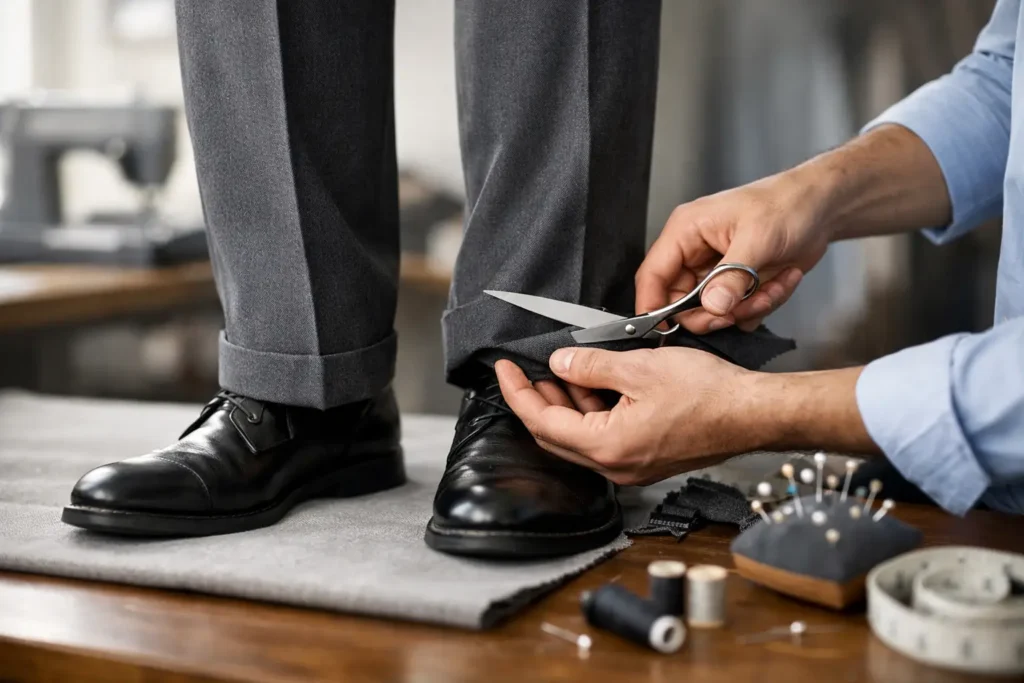
Trouser Shortening for a Better Fit
A pair of trousers can be expensive, well made and perfectly cut through the waist and leg, yet still look off if the length is wrong. Trouser shortening is one of the simplest alterations, but it has a big effect on how polished, comfortable and balanced your clothing looks.
Too long, and the fabric bunches around the ankle, wears out faster and can make even a good outfit feel untidy. Too short, and the line of the trouser is broken in the wrong place. The ideal length depends on the style of trouser, the shoe you wear with it and how you want the garment to sit when you move.
Why trouser shortening matters
Length changes more than appearance. It affects proportion, drape and how confidently you wear the garment. Full-length work trousers that collapse over the shoe can make the leg look shorter and the fabric look heavier. Cropped trousers that sit too high can feel awkward, especially in more formal settings.
This is why trouser shortening is rarely just a matter of cutting fabric off the bottom. A skilled tailor looks at the shape of the leg, the width of the hem, the weight of the cloth and where the trouser is meant to finish. A clean result should look intentional, not altered.
For many people, trouser length is also a practical issue. If you are commuting, walking often or wearing trousers throughout a long workday, too much extra fabric around the hem can catch dirt, fray quickly and feel uncomfortable. Shortening the trouser properly can help the garment last longer as well as look better.
The right length depends on the trouser
Not all trousers should break the same way. Suit trousers, business chinos, casual cotton pants, linen trousers and jeans each behave differently. The best hem length for one pair may look wrong on another.
With tailored trousers, most people want a neat break or a very slight break at the front. This gives a refined line without excessive bunching. A wider leg can usually carry a little more break, while a slim leg often looks best cleaner and straighter.
Casual trousers allow more flexibility. Some clients prefer a full-length finish that just touches the shoe, while others want a slightly shorter, more contemporary look that shows the ankle line or sits above the shoe with less stacking. Neither is automatically right. It depends on the cut, the fabric and how you wear them.
Jeans are another case where preference matters. Some people like a small stack at the ankle, particularly with boots. Others want a sharper hem with less folding over the shoe. The point of a good alteration is not to force every trouser into the same standard, but to make that specific pair work for your build and wardrobe.
What a tailor looks at during trouser shortening
A proper fitting usually starts from the ground up. Shoe height matters. If you wear dress shoes to the office and sneakers on weekends, the same trouser may sit differently depending on what is under it. This is why it helps to try trousers on with the shoes you are most likely to wear.
Posture matters too. Some people stand very upright, while others naturally lean forward or carry weight differently through the hips and seat. These small differences can change the way the hem hangs from front to back. A trouser that looks level on a hanger may need adjustment once it is on the body.
A good tailor will also consider the original finish. Some trousers have a plain hem, others have cuffs, blind hems or specific stitching details. Shortening the leg should preserve the look of the garment wherever possible. If the trousers were well designed to begin with, the alteration should respect that.
Trouser shortening and the break
The word break refers to the point where the trouser meets the shoe and creates a fold. This is often where customers feel uncertain, because they know when a hem looks wrong but cannot always explain why.
A full break creates a more traditional look, with visible fabric folding over the shoe. This can suit classic tailoring, taller frames or wider-cut trousers. A slight break is more versatile and often the safest option for modern workwear. No break gives a crisp, fashion-forward finish, but it can feel too short in conservative settings if not handled carefully.
There is no single correct answer. The right break depends on your height, the width of the trouser, the occasion and your personal preference. What matters most is balance. A shortened hem should make the trouser sit cleanly, not fight against the rest of the outfit.
When shortening is straightforward, and when it is not
Some trousers are simple to alter. A plain-hem cotton chino or standard work trouser can usually be shortened with minimal fuss, provided the new length works with the leg shape.
Other garments need more care. Tapered trousers can become too wide or too narrow in proportion if too much length is removed. Trousers with cuffs require precise reworking to keep the cuff depth looking right. Lined trousers, formalwear and garments with decorative stitching or invisible hems all need a more considered approach.
There is also the question of how much can reasonably be taken up. If a pair is far too long, the alteration may affect the leg opening and overall balance. In these cases, shortening is still possible, but it needs technical judgement. This is where experience makes a real difference.
Why DIY hemming often falls short
Temporary hemming tape or a quick hand stitch can be useful in a pinch, especially before an event. But as a long-term solution, it often shows. The hem may twist, the line may sit unevenly, or the finish may not suit the original garment.
Home sewing can also create avoidable problems. If the hem is pinned at the wrong point, trousers can end up shorter than intended once they settle on the shoe. Visible stitch lines, bulky folds and puckering are common when the fabric weight is not handled properly.
With trouser shortening, small inaccuracies are easy to spot. Because the hem sits close to the shoe and the floor, any unevenness becomes obvious when you walk. A professional finish gives cleaner movement, better symmetry and a result that looks like it belonged there from the start.
Getting the best result from your fitting
If you are bringing trousers in for shortening, wear or bring the shoes you expect to pair with them most often. That one detail helps set the right length far more accurately than guessing from memory.
It also helps to mention how you want the trousers to feel. Some customers care most about a sharp business look. Others want comfort for everyday wear, or a neater line that works across several outfits. If you have a favourite pair with the right hem length, bring that along as a reference.
Be honest about whether the trousers are for work, a wedding, travel or casual use. The ideal finish for each scenario can be different. Good tailoring is personal, and the best result usually comes from a short conversation rather than a one-size-fits-all rule.
A small alteration that changes the whole outfit
People often think of trouser shortening as a minor fix, but it can change the way an entire outfit reads. The shirt sits better. The jacket line feels sharper. The shoes look more considered. Most importantly, you stop noticing the trouser for the wrong reasons.
That is the real value of careful alterations. They remove distraction and let the garment do its job properly. Whether it is a business suit, everyday chinos or a favourite pair you are not ready to give up on, the right hem can bring the whole piece back into balance.
For Melbourne customers who want trousers to look clean, feel comfortable and last well, expert shortening is not about taking a shortcut. It is about getting the finish right, so each step feels as polished as the rest of your outfit.