


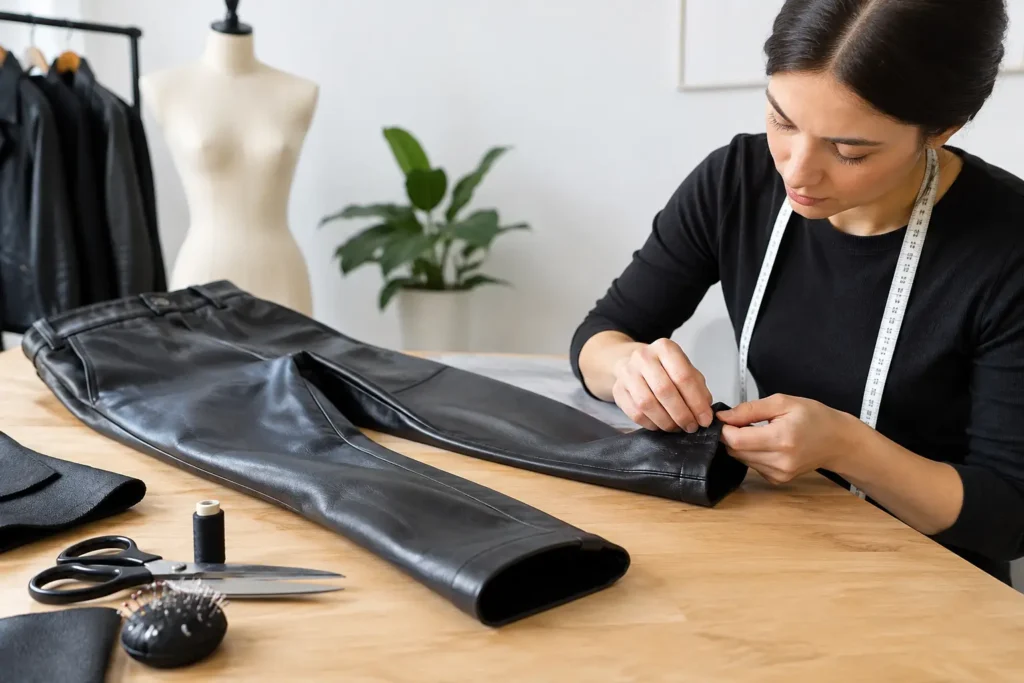
A Guide to Altering Leather Pants Properly
Leather pants should feel confident, not restrictive. If the waist gaps, the hem bunches over your boots, or the legs feel loose after wear, the right alteration can turn a rarely worn purchase into a favourite part of your wardrobe. This guide to altering leather pants explains what is realistically possible, where the risks sit, and why specialist handling matters.
Leather is not like denim, wool or cotton. Every needle hole is permanent, heat can damage the finish, and an incorrect cut cannot simply be stitched back together without leaving evidence. A careful fitting and an experienced hand make all the difference.
Why leather pants need a different approach
Leather has weight, texture and natural variation. It can stretch a little with wear, particularly across the seat and knees, but it does not behave predictably in the same way as woven fabric. A tailor needs to consider the thickness of the hide, the lining, the grain, existing seams and the way the pants move when you sit and walk.
The finish also matters. Smooth nappa leather, suede, coated leather and stretch leather blends each require different techniques. Faux leather needs care too. While it is often thinner, it can mark, crack or melt under excessive heat. The best alteration method always depends on the material and construction, not just the change you would like made.
Before any work begins, try your pants on with the shoes you expect to wear most often. Stand naturally, sit down and take a few steps. A close fit may look sharp when standing but become uncomfortable when seated, especially through the thigh and rise. Good tailoring improves the silhouette without taking away the movement that makes leather pants practical to wear.
What can be altered on leather pants?
Many common fit issues can be improved, provided there is enough material and the original construction allows for it. Shortening the hem, taking in the waist and tapering the lower leg are usually among the most achievable alterations. Adjusting a damaged zip, replacing a fastening or repairing a split seam may also be possible.
Shortening the hem
Leather pants that break too heavily over the shoe can look untidy and wear out faster at the back hem. A professional can shorten them while preserving the original shape, whether the pants have a plain edge, zip opening, cuff or detailed finish.
Hemming leather is more involved than folding and stitching fabric. The edge may need to be trimmed precisely, finished cleanly and sewn with suitable needles and thread. If the pants have a lined leg, the lining needs to sit comfortably and not pull when you move. Getting the length right at the fitting stage is essential because there is little room to reverse the decision.
Taking in the waist
A waist alteration can improve comfort and stop the back of the pants from gaping. Depending on the design, the adjustment may be made through the centre back seam, side seams or waistband. The ideal method is the one that maintains the balance of pockets, belt loops and panels.
Taking in a modest amount usually produces the cleanest result. A large reduction can affect the placement of back pockets or distort shaped seams, so a tailor may recommend combining a waist adjustment with changes through the seat or side seams. This is not a limitation of skill – it is about retaining a natural, well-proportioned finish.
Tapering the legs
If leather pants feel too wide below the knee, tapering can create a neater line and make them easier to style with ankle boots, loafers or heels. The work is generally completed through the inside leg seam, the outside seam, or both, depending on where the excess sits.
Tapering needs to follow the natural line of your leg. Removing too much can make the calves feel tight or cause the leather to pull across the knee. For slim-fitting styles, a fitting while standing and sitting helps establish a shape that looks refined without becoming restrictive.
Repairs to seams, zips and linings
A split seam does not always mean your leather pants are finished. If the leather itself remains sound, the seam may be reinforced and restitched. Worn linings can sometimes be repaired or replaced in key areas, while broken zips and hooks may be changed if compatible hardware is available.
Repair work should be assessed before any promises are made. A tear through the body of the leather, especially near a high-stress area, can be more complex than a seam opening. A repair may still extend the life of the garment, but an honest tailor will explain if a repaired area is likely to remain visible.
What is difficult or not advisable?
Letting leather pants out is often more limited than taking them in. Most garments have very little seam allowance, and previous stitching leaves a line of needle holes that cannot be hidden once opened. If the pants are too small through the hips, thighs or rise, there may be no suitable extra material to release.
Major changes to the rise are also risky. The rise affects how the pants sit from the waist through the crotch and seat, so altering it can change the proportions of the whole garment. Similarly, moving pockets, removing large panels or reshaping heavily detailed leather pants may leave visible marks from original stitching.
It is tempting to try a quick home fix with clips, glue or a domestic sewing machine. However, clips can leave dents, glue can stiffen or stain the leather, and a sewing machine can create uneven permanent holes. Leather is one of the garments where a small mistake is often more expensive to correct than the original alteration.
Preparing for a leather pants fitting
Bring the shoes and belt you wear with the pants, particularly if you are having the hem or waist adjusted. Wear a thin top that allows the waistband to be seen clearly, rather than a bulky jumper that changes the fit. If you plan to wear the pants for a particular event, mention the date early so the alteration can be planned around it.
During the fitting, explain how you want the pants to feel as well as how you want them to look. Some clients prefer a streamlined, fashion-forward fit; others need more room for commuting, driving or long evenings out. There is no single correct fit. The goal is to make the pants work for your body and your routine.
It also helps to point out any areas that already concern you, such as rubbing at the inner thigh, a zip that catches, or a waistband that rolls. Addressing a small issue early can prevent further wear and help preserve an investment piece.
How professional leather alterations are completed
A quality leather alteration begins with assessment, not cutting. The tailor checks the leather condition, seam allowances, lining, hardware and panel layout before marking the proposed adjustment. Pins are used sparingly or avoided where they could mark the surface, and the garment is handled to prevent stretching.
Once the fit is confirmed, stitching is completed with equipment, needles and thread suited to the leather. Seams must lie flat without puckering, while the tension needs to be secure enough for movement without perforating or weakening the material. Any lining is finished so it supports the garment rather than fighting against it.
At AD Stitch, leather alterations are approached with the same precision as tailored suits and special-occasion garments. The aim is not simply to make a measurement smaller. It is to preserve the character of the pants while giving you a fit that feels comfortable, polished and worth wearing again.
Care after altering leather pants
After alteration, avoid overloading pockets or forcing tight leather pants through repeated deep bends while they are new to the adjusted fit. Hang them rather than folding them tightly, and keep them away from direct heat and prolonged sun exposure. If they become wet, allow them to dry naturally at room temperature rather than placing them near a heater.
For cleaning and conditioning, follow the garment label and use products made for that specific leather type. Suede, smooth leather and coated finishes should not be treated in the same way. When in doubt, seek specialist advice before applying a cleaner, conditioner or waterproofing product to a visible area.
A well-made pair of leather pants deserves more than a compromise fit. With a careful assessment and skilled alteration, they can sit better, move better and become the pair you reach for whenever you want to feel put together.