


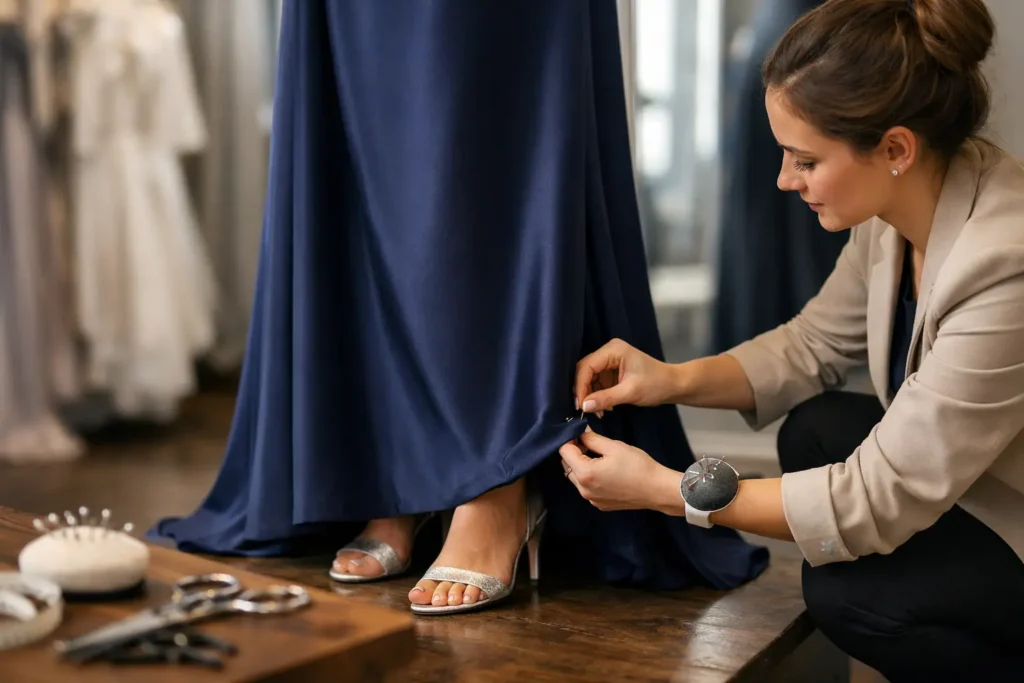
Formal Dress Hemming Advice for a Polished Fit
A formal dress can be beautifully made and still look unfinished if the hem is wrong. Too long, and you risk catching it under your heel, dragging the fabric or feeling hesitant with every step. Too short, and the proportions can change completely. This formal dress hemming advice will help you prepare for an alteration that looks refined, feels comfortable and suits the way you will actually wear your dress.
Start with the shoes, not the dress
The most reliable hem length depends on your event shoes. Even a small difference in heel height can affect where a floor-length dress sits, particularly with a slim silhouette, a soft drape or a long train. Bring the exact shoes you plan to wear to your fitting, rather than a similar pair from your wardrobe.
This matters just as much for block heels and platforms as it does for stilettos. A platform may look like a high shoe but provide a lower effective heel height, while a shoe with a narrow heel can alter your posture and the way the skirt falls. If you are deciding between two pairs, choose your shoes before finalising the hem wherever possible.
For a formal gown, stand naturally during the fitting. Do not stretch tall, pull your shoulders back more than usual or hold your stomach in. Your tailor needs to see how the dress falls when you are relaxed, because that is how it will sit through a long dinner, ceremony or dance floor.
How should a formal dress hem sit?
There is no single correct length. The best result depends on the dress shape, fabric and event, as well as how much movement you need.
A full-length gown usually sits just above the floor at the front when worn with the chosen shoes. The hem should clear the ground enough to prevent you stepping on it, while still giving the long, elegant line the design intended. A small amount of contact at the back can be appropriate for certain soft evening gowns, but a hem that pools around your feet is impractical and likely to show wear quickly.
For a fitted or mermaid-style dress, adequate clearance is especially important. The narrower skirt already restricts stride, so too much length can make stairs and uneven paths difficult. An A-line or ball gown has more volume and may look balanced at a slightly different point, particularly if the skirt has a structured petticoat.
Tea-length and midi formal dresses are more about proportion. The hem should fall at a deliberate point on the leg, rather than landing awkwardly at the widest part of the calf. A skilled fitting considers your height, shoe shape and the dress’s original lines before recommending an adjustment.
Formal dress hemming advice for different fabrics
Fabric is one of the biggest factors in a successful hem. The finish that works beautifully on a structured satin skirt may not suit a floating chiffon overlay.
Chiffon, georgette and lightweight layers
Fine, sheer fabrics can shift while they are handled and may hang differently after they have rested. These dresses often need careful measuring, pinning and trimming across several layers. Each layer may require a separate finish to retain movement without adding visible weight at the edge.
A narrow rolled hem is often suitable for light fabrics, but it needs to be even and soft. If the dress has a layered skirt, shortening only the outer layer can leave the lining visible when you walk. Your tailor should assess the whole construction, not just what is obvious on the hanger.
Satin, crepe and heavier evening fabrics
These fabrics can show needle marks, pressing marks and uneven stitching more readily, so precision matters. Satin also catches the light, which can make even a slight variation in the hemline noticeable. Depending on the garment, the original hem may be recreated or a new finish chosen that sits cleanly and does not distort the skirt.
Crepe has a beautiful drape but can stretch slightly on the bias. It is worth allowing the dress to hang before the final fitting, especially if it has been stored folded or has travelled in a garment bag.
Lace, beading and embellished hems
Lace and embellishment call for a more considered approach than a straightforward trim. If the design continues to the edge of the skirt, simply cutting up the hem can remove the detail that gives the dress its finish. In many cases, appliqués can be carefully lifted and repositioned, or the dress can be shortened from a different seam. The right method depends on construction, budget and how much length needs to come off.
Beaded gowns also carry weight. Once altered, the skirt may hang differently, so an experienced tailor will check the balance carefully. This is not a job to leave until the day before an event.
Do not overlook the lining and train
A polished hem is about more than the visible outer skirt. The lining needs to move comfortably underneath and should not hang lower than the outer layer unless that contrast is part of the original design. An uneven lining can catch on shoes, twist inside the dress or create a bulky look at the hem.
If your dress has a train, discuss how you plan to use it during the event. You may want it left at full length for photographs and the ceremony, then secured with a bustle for dancing. A bustle is designed to lift and hold the train using discreet loops, buttons, hooks or ties. It must be positioned for the gown’s weight and fabric, then tested properly before the event.
Ask someone attending with you to learn how the bustle works. A beautiful bustle is only useful if a friend, family member or bridal party member can fasten it without guesswork when the time comes.
Allow time for more than one fitting
The best formal dress alterations are rarely rushed. Ideally, book your first fitting several weeks before the event, allowing extra time for bridal gowns, detailed beading, multiple layers or significant changes. This gives your tailor time to assess the garment, complete the work carefully and make minor refinements if needed.
Your body can also change slightly between fittings due to routine, stress, travel or a change in undergarments. If the dress is close-fitting, bring the bra, shapewear or slip you will wear on the day. These pieces affect not only the bodice but also the overall balance of the skirt.
When you collect the dress, walk in it. Take a few normal steps, turn, sit down if appropriate and practise climbing a step. Check that you can move without catching the hem and that the lining stays where it should. This simple test is often the difference between a dress that merely fits and one that feels dependable.
Common hemming mistakes to avoid
The most common mistake is measuring a long dress barefoot. Another is changing shoes after the hem has been completed. Both can leave a formal gown sitting at the wrong length, even when the alteration itself has been done perfectly.
It is also tempting to request the shortest possible hem to avoid tripping. That can be sensible for a busy event with stairs, grass or plenty of dancing, but too much shortening can alter the intended silhouette. The practical answer is usually a considered clearance, not an excessive one.
Avoid using temporary tape as a final solution for valuable formalwear. It can fail with heat, movement or delicate fabrics, and it may leave residue. For an emergency it has a place, but a professionally sewn hem is more secure, comfortable and discreet.
Bring the whole outfit to your fitting
A formal dress is not worn in isolation. Bring your event shoes, undergarments and any petticoat or slip that affects the length. If you have chosen a statement earring or jacket, it is not essential for hemming, but it can help you see the finished proportions and feel confident in your final look.
At AD Stitch in Heidelberg, formal dresses are assessed as complete garments, with attention to fabric, lining, movement and the finish at the hem. That careful approach is particularly valuable when a dress has sentimental value, intricate detail or a special event behind it.
Give your dress the fitting time it deserves. When the hem is measured with the right shoes, finished for the fabric and checked in motion, you can focus on enjoying the occasion rather than watching every step.