


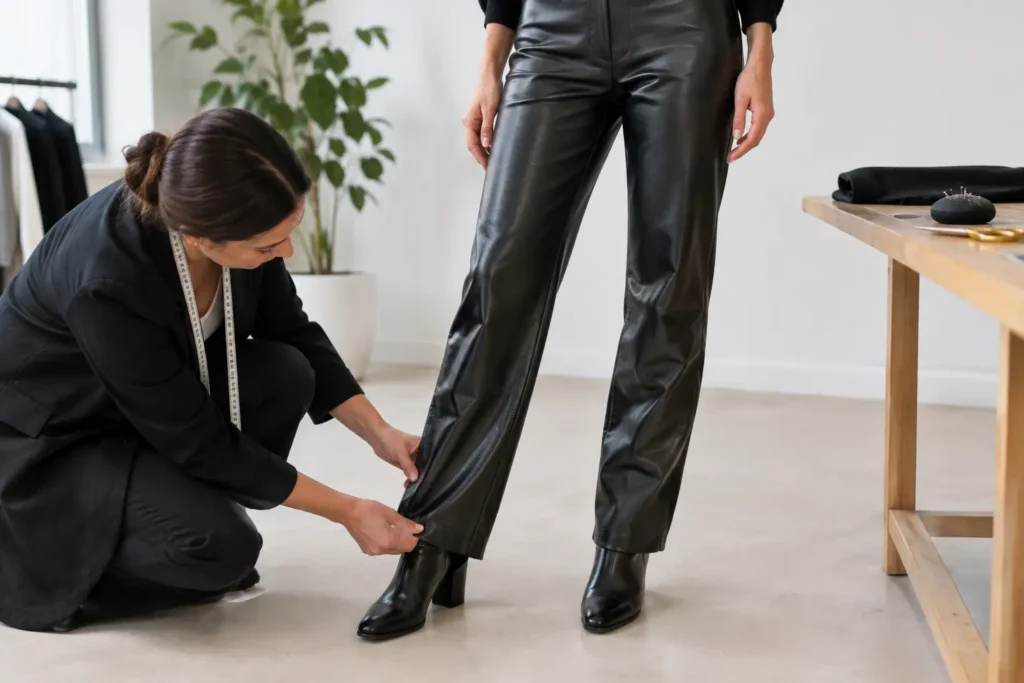
Can Leather Trousers Be Altered? What to Know
A pair of leather trousers that sits beautifully through the hip but gaps at the waist is too good to leave unworn. So, can leather trousers be altered? In many cases, yes. The right alteration can turn an almost-right pair into a favourite, but leather needs more specialised handling than denim, wool or cotton. The success of the job depends on the leather itself, the construction of the trousers and how much needs changing.
Can leather trousers be altered successfully?
Leather trousers can often be taken in at the waist, shortened, tapered through the leg and repaired at worn seams. Small to moderate adjustments usually give the cleanest result, particularly when the trousers are well made and the leather is still supple. A skilled tailor assesses the garment before cutting or unpicking anything, because every stitch mark in leather can be permanent.
Unlike fabric, leather does not recover readily once it has been pierced by a needle. That means an alteration cannot simply be trialled, undone and sewn again without leaving evidence behind. The work needs to be planned precisely from the beginning, with the correct machinery, needles, thread and sewing technique for the leather’s weight and finish.
A professional assessment is especially worthwhile for trousers with a lining, stretch panels, decorative topstitching, multiple zips or a contoured waistband. These details affect where the garment can be altered and how natural the finished result will look.
The alterations that work best
Taking in the waist
A waist reduction is one of the most requested leather trouser alterations. If the waistband gapes at the back but the hip and seat fit well, a tailor may be able to take in the centre back seam or adjust the side seams. The best method depends on the placement of belt loops, pockets, yokes and zips.
A modest reduction generally preserves the original shape. Larger reductions are possible on some styles, but they may change the pocket position or make the waistband look less balanced. A fitting is the best way to determine whether the trousers should be adjusted at the waist alone or through the back seam and seat as well.
Shortening the length
Leather trousers can be shortened, although the original hem finish matters. A plain hem is usually more straightforward than a cuff, zip opening or panelled ankle detail. The tailor will mark the length while you are wearing the shoes you intend to wear most often with the trousers.
Leather does not behave like a fabric hem that can be pressed into place. Some styles need a carefully turned and stitched hem, while others look better with a clean cut finished according to the garment’s original design. Keeping the proportions right around the ankle is just as important as choosing the correct length.
Tapering the leg
If leather trousers fit at the waist and hip but feel too loose below the knee, tapering can create a cleaner silhouette. This is often done through the inseam or outer seam, depending on the pocket placement and design lines. A gradual adjustment tends to look more natural than taking out too much at one point.
Tapering works well on straight-leg and relaxed styles when there is enough room to remove. Very fitted leather trousers offer less flexibility, as taking them in too far can restrict movement and place strain on the seams when sitting or walking.
Repairs and seam adjustments
Split seams, loose hems and damaged stitching can often be repaired before the problem worsens. Leather trousers may also need attention around the inner thigh, where friction and movement create wear over time. Early repair can extend the life of a quality garment and prevent a small weakness from becoming a larger tear.
A repair is not always invisible, particularly if the leather has faded, stretched or cracked. However, careful colour matching, neat stitching and reinforcement from the inside can make the trousers wearable and presentable again.
When altering leather trousers may not be the best option
Not every pair is a good candidate for alteration. Leather that is dry, brittle, peeling or heavily cracked may not tolerate unpicking and resewing. Faux leather can be even less predictable, as some coated materials leave visible holes or begin to flake once seams are opened.
Trousers that need to be made substantially bigger are also difficult. There is rarely enough seam allowance in leather garments to let them out by more than a small amount. Adding panels is technically possible in some cases, but it changes the original look and may not be cost-effective unless the trousers are particularly valuable or sentimental.
Very detailed designs need extra consideration. Moto-style trousers with knee panels, zip pockets, quilting or heavy hardware can be altered, but the job is more complex. The adjustment must respect the garment’s construction rather than force it into a shape it was not designed to hold.
Why leather requires specialist handling
The quality of an alteration comes down to more than measuring and stitching. Leather can show needle holes, marking, pressure lines and uneven tension far more clearly than most fabrics. It also has natural variations in thickness and stretch, even within the same pair of trousers.
A tailor experienced with leather uses techniques that minimise unnecessary handling. Seams are opened carefully, markings are kept discreet and the garment is supported properly while it is being worked on. The stitching must be strong enough for movement without pulling, puckering or cutting into the leather.
Lined trousers add another layer of work. The lining often needs to be opened, adjusted and resewn so it sits smoothly inside the finished garment. If this is rushed, the trousers can twist, feel tight in the wrong places or lose their comfortable drape.
Get the fit right before the work begins
Bring the trousers to a fitting with the underwear and shoes you would normally wear with them. Leather can feel different after a few minutes of movement, so walk, sit and bend during the fitting. A pair that looks fine when standing still may pull at the thigh, knee or seat once you move.
Be clear about what is bothering you. Is the waistband sliding down? Is the inseam too long? Do the legs feel bulky, or is the issue actually the cut around the hip? The most useful alteration is not always the most obvious one. Sometimes a small waist adjustment and a careful taper provide a better result than trying to reshape the entire garment.
It is also sensible to discuss your expectations honestly. If you want a dramatic change from a relaxed fit to a close-fitting silhouette, the tailor can explain whether the leather and seam allowances will support it. A good alteration should improve comfort as well as appearance.
Caring for altered leather trousers
Once altered, leather trousers deserve a little extra care. Hang them on a sturdy trouser hanger or fold them loosely to avoid deep creases. Keep them away from prolonged heat and direct sunlight, which can dry the leather and affect its colour.
Avoid washing leather trousers in a standard washing machine or treating stains with household cleaners. Use leather-appropriate care products only when suitable for the garment, and test any product in a hidden area first. If the trousers become wet, let them dry naturally away from heaters.
Regular wear can soften leather and help it mould comfortably to your shape. If you notice loose stitches, a lifting hem or stress around a seam, have it checked promptly. Small repairs are usually simpler and more discreet than waiting for the damage to spread.
For Melbourne customers with a pair that is close but not quite right, AD Stitch can assess the construction, fit and condition before recommending the most suitable alteration. The aim is not to change leather trousers for the sake of it, but to preserve what makes them worth wearing while giving you a fit that feels confident every time you put them on.