


Can Dresses Be Taken In? What to Know
A dress can look nearly right on the hanger and still feel wrong the moment you put it on. Maybe the bodice sits away from your body, the waist lacks shape, or the skirt feels a size too generous. If you’ve been wondering can dresses be taken in, the short answer is yes – very often they can. The better answer is that it depends on how the dress is made, where it needs adjustment, and how much change is required.
A well-executed alteration is not just about making a dress smaller. It is about restoring proportion, balance and comfort so the garment sits properly on your body. That is where expert clothing alterations make a real difference.
Can dresses be taken in at the waist, bust or hips?
In many cases, yes. Most dresses can be taken in through the side seams, back seam, darts or waist seam, depending on the style. A fitted work dress, cocktail dress or bridesmaid dress is often very alterable because it already has seam structure that allows a tailor to refine the shape.
The waist is one of the most common areas to adjust. If a dress fits through the shoulders but feels loose through the middle, taking in the waist can create a cleaner silhouette without changing the character of the garment. The bust area can also be improved, especially if there is gaping or too much fullness. At the hips, it becomes more style-dependent. A straight or tailored shape can usually be reduced more easily than a dress designed to drape or skim loosely.
The key is whether there is enough seam allowance and whether the fabric will behave well once reshaped. Structured dresses usually respond better than very delicate or highly stretchy ones.
What makes a dress easier or harder to take in?
Construction matters more than many people realise. Two dresses may look similar on the rack, but one may alter beautifully while the other becomes a complicated job once opened up.
A dress is usually easier to take in when it has clear seams, stable fabric and a relatively simple lining. Dresses with princess seams, centre back seams, or side seams give a tailor more options for refining fit. Plain woven fabrics also tend to hold shape well after adjustment.
Things become trickier when a dress has heavy beading, sequins, lace overlays, pleating, boning, draping or asymmetrical design lines. None of these details make alteration impossible, but they do increase the labour and skill required. The same is true for dresses made from slippery satin, chiffon, silk blends or fabrics that show every needle mark.
A fully lined dress also needs both the outer fabric and the lining adjusted correctly. If only the outside is altered and the lining is left fighting against it, the dress can twist, pull or sit awkwardly.
How much can a dress be taken in?
This is where expectations need to be realistic. Small to moderate reductions are usually straightforward. Taking in a dress by one size, or refining several areas for a neater fit, is often very achievable. Larger changes are possible in some garments, but they are not always the best value or the best result.
Once a dress needs major reshaping, the tailor may effectively be rebuilding parts of it. The armholes, neckline, bust point, waist placement and zip area can all be affected. What began as a simple “make it smaller” request can become a structural alteration.
That does not mean it should not be done. It simply means the garment needs to justify the work. For an occasion dress, a quality piece or something sentimental, the answer may still be yes. For a fast-fashion item with limited construction quality, the alteration cost can outweigh the value.
Can all dress styles be taken in?
Most styles can be adjusted to some degree, but not all in the same way.
Bodycon and fitted dresses are often altered through the side seams and back seam, provided the fabric and stitching can cope. A-line dresses can usually be taken in at the bodice and upper waist while preserving the flare below. Shift dresses are common candidates for reshaping because they can look boxy when slightly too large.
Formal dresses and evening wear are more mixed. They often can be altered, but decorative details may slow the process. Wedding and bridesmaid dresses are a category of their own because fit is critical and the garments often include multiple layers, cups, boning or lace. These dresses are frequently altered, but they require careful handling.
Stretch dresses can also be taken in, though success depends on maintaining the garment’s balance. If too much is removed without understanding the fabric recovery, the dress may ripple or lose its intended line.
Signs your dress is a good candidate for taking in
If the shoulders sit correctly and the overall style suits you, that is a strong start. A dress that is just loose through the torso or hips is usually more promising than one that is wrong everywhere.
Another good sign is visible seam allowance inside the garment. While customers do not need to inspect every stitch, it helps if the dress has some construction substance rather than being cut to the bare minimum. Quality garments generally allow for better, cleaner alterations.
It also helps when the issue is fit rather than design. If you love the dress but it just lacks shape, a tailor can often solve that. If you dislike where the waist falls, how the neckline sits and how the skirt hangs all at once, the problem may be the dress itself rather than the size.
When taking a dress in may not be the best option
Sometimes the honest advice is that a dress should be left alone, or replaced with a better starting point. If the fabric is fragile, badly stretched, or marked by previous alterations, further work may compromise it. Very cheap garments can also present issues because the stitching, fabric stability and finishing are not strong enough to support refined tailoring.
Another common issue is proportion. If a dress is too large in every dimension, taking in the seams may not correct features like oversized armholes, a neckline that sits too low, or bust shaping that falls in the wrong place. A skilled tailor can assess whether the garment can be rebalanced, but there are limits.
This is why an in-person fitting matters. What seems like a simple loose dress can turn out to be a complex pattern problem once it is on the body.
What to expect at a fitting when a dress is being taken in
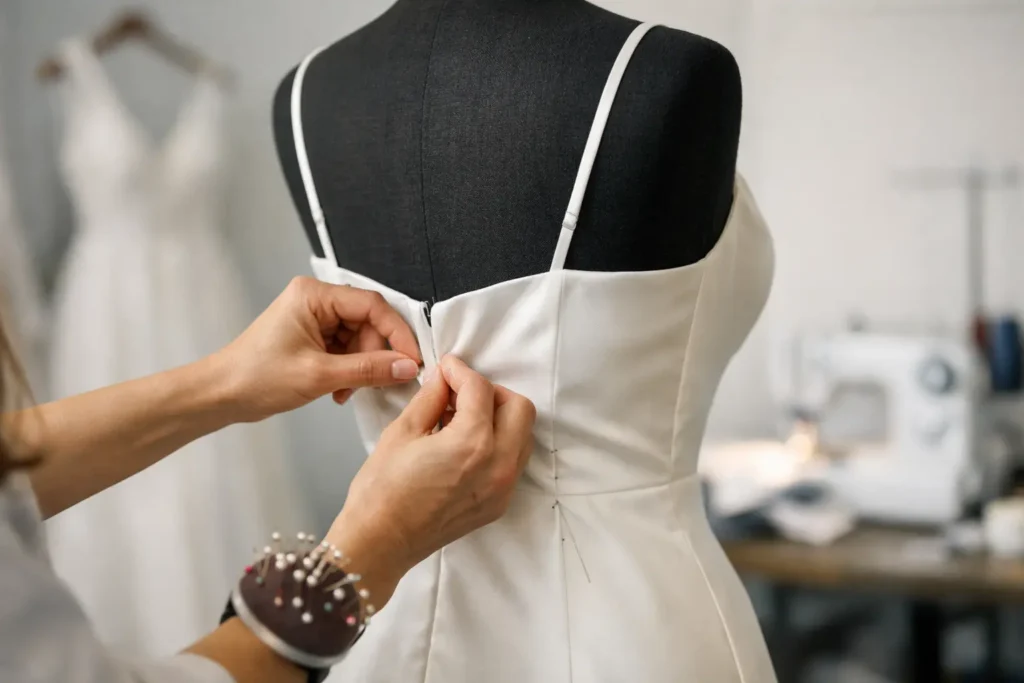
A proper fitting should feel specific, not rushed. The tailor will usually pin the dress on your body to identify where excess fabric sits and how the adjustment should be distributed. This is important because taking all the fullness from one seam can distort the garment. Often, the best result comes from balancing changes across side seams, darts and the back.
You may be asked about shoes, undergarments or when you plan to wear the dress. That is not small talk. These details affect how a dress sits and whether the final fit feels right on the day you need it.
If the dress has lining, embellishment or delicate fabric, the tailor may explain any limitations before work begins. That is a good sign. Clear, practical advice is part of quality service.
Can dresses be taken in without changing the look?
Usually, yes – if the alteration is planned properly. The goal is to improve fit while keeping the original design intact. On a simple dress, that can be quite seamless. On a more detailed garment, preserving the look takes more craftsmanship.
For example, a dress with lace edging or beadwork may need portions carefully removed and reapplied. A shaped seam may need to be adjusted in a way that preserves the line of the bodice. Even a zip may need repositioning so the back sits flat.
This is where experience counts. A dress should not end up looking obviously altered. It should simply look as though it was made to fit you.
Getting the best result from dress alterations
If you suspect a dress needs taking in, do not wait until the last minute, especially for eventwear. More complex garments need time, and multiple fittings are sometimes the best path to a precise result.
Bring the shoes and undergarments you intend to wear, and be honest about how you want the dress to feel. Some people prefer a close, sculpted fit. Others want room to sit, move and breathe comfortably. Neither is wrong, but your tailor needs to know the difference.
For Melbourne customers wanting a trusted local business, this is exactly the kind of work handled every day at AD Stitch – careful fitting, clear advice and alterations that respect both the garment and the person wearing it.
A dress that is slightly too big is not necessarily a mistake purchase. With the right craftsmanship, it can become one of the hardest-working pieces in your wardrobe – one that feels comfortable, looks polished and finally fits the way it should.