


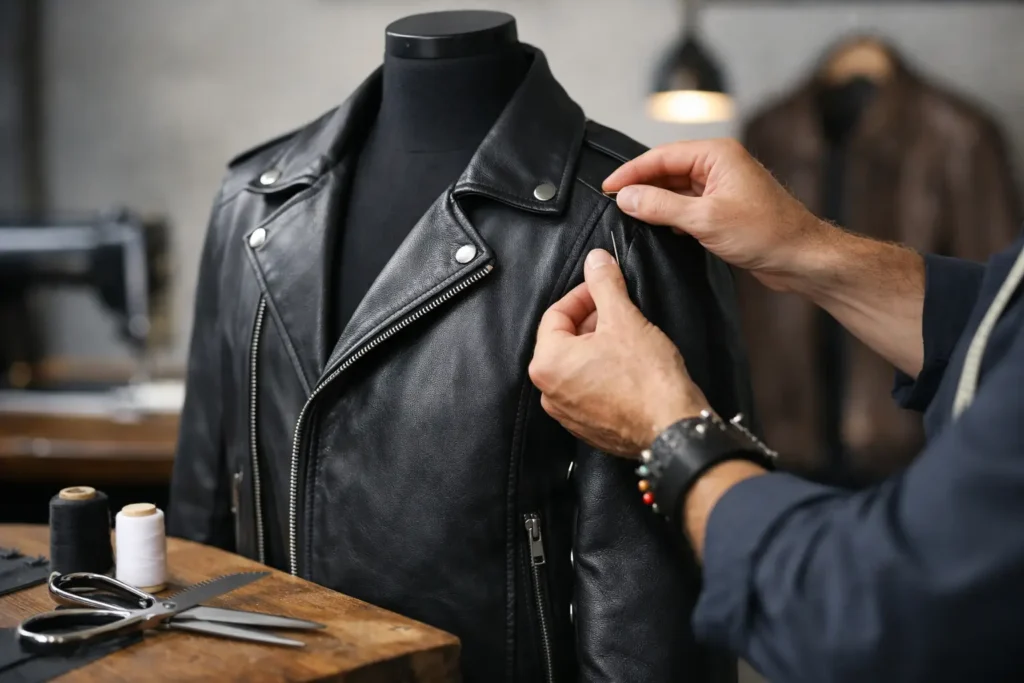
Can Leather Jackets Be Tailored?
That leather jacket looked perfect on the hanger, but once it was on your body the sleeves felt too long, the shoulders sat wide, or the waist didn’t quite follow your shape. It’s a common problem, and the good news is that can leather jackets be tailored is usually answered with yes. The better question is what can be tailored safely, and what should be left alone.
Leather is very different from cotton, wool, or denim. Every stitch leaves a mark, every needle hole is permanent, and the material has its own weight, stretch, and grain. That means alterations are possible, but they need a careful hand and realistic expectations. A well-planned leather alteration can sharpen the fit beautifully. A poor one can leave visible damage that’s hard to hide.
Can leather jackets be tailored successfully?
Yes, many leather jackets can be tailored successfully, especially when the issue is in the sleeves, body width, jacket length, or zip area. The key is whether the existing construction allows the garment to be adjusted without disturbing its balance.
A good tailor starts by looking at more than just the size. They assess the lining, panel seams, hardware, topstitching, edge finish, shoulder structure, and the condition of the leather itself. A soft lambskin biker jacket behaves very differently from a thick cowhide moto jacket, and both require a different approach again from a suede piece.
This is why leather alterations are never a one-size-fits-all service. Two jackets may look similar on the outside but have completely different internal construction. One may be straightforward to refine. The other may not be worth touching.
What parts of a leather jacket can be tailored?
The most successful alterations are usually the ones that work with the jacket’s existing seam lines.
Sleeves
Sleeve shortening is one of the more common leather jacket alterations. If the sleeves are bunching over your hands or covering too much of your wrist, they can often be shortened from the cuff or sometimes from the shoulder, depending on the zip detail, cuff design, and lining.
This matters more than many people realise. Sleeve length affects the whole look of the jacket. Even an expensive leather jacket can appear oversized if the sleeves are too long.
Body width
If the jacket feels boxy through the waist or too loose through the torso, it may be possible to taper it through the side seams or back seams. This can create a cleaner silhouette without changing the style of the jacket.
That said, there’s a limit. Taking in too much can pull the pockets out of place, distort the zip line, or create drag lines across the front. The best result is usually a subtle refinement, not a dramatic reshape.
Jacket length
Shortening the body of a leather jacket can be possible, but it depends heavily on the design. If there are pockets, belts, ribbing, or decorative seam panels near the hem, the job becomes more complex. With simple styles, shortening can work well. With heavily detailed jackets, the alteration may compromise the original proportions.
Zip replacement and repairs
Sometimes the issue is not the fit but wear and tear. A broken zip, torn lining, damaged seam, or split panel can often be repaired. Leather jackets are worth maintaining because they tend to improve with age when properly cared for. A repair can bring a favourite jacket back into regular wear without changing its character.
What is difficult to alter?
Some changes are technically possible but not always advisable.
Shoulders
Shoulder alterations on leather jackets are among the most difficult. The shoulder line controls how the whole jacket hangs, and changing it often means reconstructing the sleeve head, armhole, lining, and upper body. On structured styles, this can become labour-intensive and expensive very quickly.
If the shoulders are only slightly broad, another adjustment elsewhere may improve the overall fit enough to make the jacket wearable. If the shoulders are far too large, replacement is often the better option.
Armholes
Raising or reshaping armholes in leather is delicate work. Because leather holds stitch marks, any correction has to be exact. A failed adjustment can leave permanent evidence behind.
Major size changes
Taking a jacket down one size may be realistic. Trying to reduce it by several sizes is usually not. At that point, the position of the pockets, collar, lapels, and hardware can all become visually off-balance. A leather jacket should still look like it was made that way, not forced into a new shape.
Why leather tailoring needs specialist skill
Leather does not forgive rough handling. Unlike woven fabric, it cannot simply be unpicked, pressed, and restitched with no trace. Needle holes remain. Surface finishes can mark. Heat must be controlled carefully. Even the choice of machine, thread, and presser foot matters.
That’s why leather tailoring sits closer to craftsmanship than standard clothing alterations. The tailor needs to understand how the hide will respond, how to work around linings and hardware, and how to preserve the original design. Precision is not just about measurement. It is about restraint.
For customers, this means the fitting conversation matters. A skilled tailor will tell you not only what can be done, but what should not be done. Honest advice protects both the garment and the result.
How to tell if your jacket is worth tailoring
Not every leather jacket should be altered. Some are excellent candidates, while others are better left as they are.
The strongest candidates are jackets with quality leather, good structure, and a fit problem that is localised rather than overall. Maybe the body fits but the sleeves are too long. Maybe the shoulders are right but the waist is too loose. These are the kinds of issues that tailoring can often improve.
Condition also matters. If the leather is cracking, badly stretched, or weakened around old stitch lines, alterations become riskier. Vintage jackets can be especially rewarding to save, but they need a careful assessment first.
Price should be looked at sensibly as well. A good alteration can extend the life of a quality jacket for years, which often makes it worthwhile. But if the jacket was cheaply made and fits poorly in several areas, extensive work may cost more than the garment justifies.
What to expect at a fitting
A proper fitting for a leather jacket is usually more detailed than a standard trouser hem or shirt adjustment. The tailor will want to see how the jacket sits when zipped and unzipped, how the sleeves break at the wrist, and whether the jacket pulls when you move your arms or sit down.
It helps to wear the sort of clothing you would normally wear underneath. A leather jacket over a thin T-shirt can fit differently from the same jacket over a knit or business shirt. If you use the jacket in cooler months, say so. Fit should reflect real wear, not just the fitting room.
You may also be advised to prioritise one change over another. For example, fixing sleeve length may make the whole jacket look sharper, even if the body is still slightly roomy. Good tailoring is not about changing everything. It is about improving what matters most.
Can alterations change comfort as well as appearance?
Absolutely. Fit is not only visual. A jacket that sits properly in the shoulders, sleeves, and torso is easier to move in and more pleasant to wear. If the sleeves stop at the right point, your hands feel freer. If the body is shaped properly, the jacket feels less bulky. If the zip closes smoothly and the lining sits flat, the garment works as intended.
That is often why people choose to tailor leather rather than replace it. A well-made leather jacket has character. Once it starts to mould to your life, you don’t necessarily want a new one. You want the same jacket, just fitting better.
When to leave a leather jacket alone
There are times when the smartest decision is to avoid alteration. If the jacket is too small across the back or chest, letting it out is often limited by seam allowance and construction. If the shoulder line is badly wrong, the cost and risk may outweigh the benefit. If the design includes heavy panel work, topstitching, or decorative hardware in all the wrong places, preserving the original look may be more important than chasing a perfect fit.
A trustworthy tailor will tell you when a jacket can be improved and when expectations need to stay modest. That honesty is part of good service.
For anyone in Melbourne with a leather jacket that almost works but not quite, a professional fitting is the clearest way to know your options. Sometimes a small adjustment is all it takes to turn a jacket you rarely wear into one you reach for every week. And that is usually the best kind of tailoring – practical, precise, and worth it.