


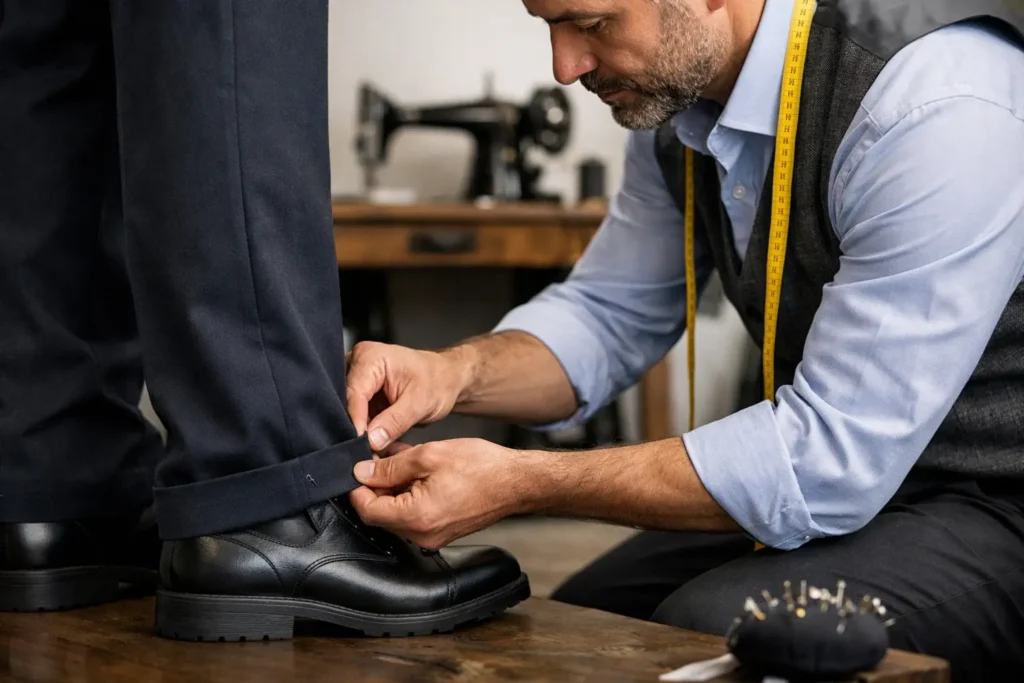
Tailor for Workwear Adjustments That Last
That jacket that pulls across the back in meetings, the trousers that bunch at the ankle, the shirt sleeves that swallow your hands – these are exactly the sort of problems a tailor for workwear adjustments can fix. Good work clothes should help you feel polished and comfortable through a full day, not leave you tugging, rolling or second-guessing how you look.
Workwear takes a different kind of wear from occasion clothing. It is worn often, washed regularly and expected to perform from the first coffee run to the last appointment. That means the fit has to do more than look neat on a hanger. It needs to move with you, sit properly when you are standing or seated, and hold its shape after repeated use.
Why workwear fit matters more than people think
When clothing fits well, the difference is immediate. Trousers sit where they should. Jacket sleeves finish neatly at the wrist. Shirts stay balanced through the shoulders rather than dragging backward or ballooning through the waist. You stop fussing with your clothes and start getting on with your day.
There is also a practical side to it. Poorly fitting workwear tends to wear out faster in the wrong places. Strain at the seat, thighs, underarms or button line can shorten the life of the garment. A precise alteration can reduce that stress and help a quality piece last longer, which is often a smarter choice than replacing it too soon.
For many professionals, fit also affects confidence. Whether you work in an office, on a customer-facing floor, in hospitality or in a role that requires a clean uniformed appearance, clothing that fits properly sends a message of care and professionalism without trying too hard.
What a tailor for workwear adjustments can actually change
Many people assume tailoring only means taking in a waist or shortening a hem. In reality, workwear alterations can be quite detailed, depending on the garment and its construction.
Trousers are among the most common items to adjust. Hemming is the obvious one, but rise, waist suppression, tapering through the leg and seat refinements can all make a major difference. The right trouser length depends on the cut, the shoe and how formal the garment is meant to look. A full break may suit some trousers, while others look cleaner with little to no break.
Shirts are another frequent request. Sleeves can often be shortened, side seams can be tapered, darts can improve shape, and excess fabric through the body can be reduced so the shirt sits neatly under a jacket. The shoulder area is more complex. If a shirt is significantly too broad there, the fix may not be worthwhile unless the garment itself is of very good quality.
Blazers and suit jackets can also be improved dramatically, but they require skilled handling. Sleeves, body shape, jacket length in some cases, and overall balance can be adjusted. However, not every change is simple. Shoulder reconstruction, armhole changes and major collar corrections are more technical and may not always be the most cost-effective option.
Skirts, dresses and women’s workwear often need reshaping through the waist, bust, hip or hem. For structured dresses and lined garments, an alteration should preserve both the external line and the internal finish. That is where expert craftsmanship matters.
Uniforms, scrubs and trade clothing can also be altered, although practicality comes first. Movement, wash frequency and fabric durability all need to be considered before making changes.
The most common workwear fit problems
Some fit issues show up the moment you put a garment on. Others only become obvious after a normal day of wear. A good fitter will look at both.
Sleeves that are too long are common, especially in jackets bought off the rack. They can make even expensive workwear look unfinished. Trouser hems are another giveaway. Too long and they puddle; too short and the proportions feel off.
Waist fit is often misunderstood. People focus on whether they can button the garment, but the real question is whether it sits cleanly without pulling or collapsing. Shirts that gape, trousers that dig in while seated, and skirts that rotate as you walk usually need adjustment.
Then there is proportion. A jacket may technically fit the chest but still look wrong if the sleeves are too wide, the waist too boxy or the hem too long for the wearer’s frame. Good tailoring is not just about tight or loose. It is about balance.
When tailoring is worth it – and when it is not
Not every garment deserves extensive alteration. The value depends on the quality of the piece, the complexity of the work and how often you will wear it.
If you have a well-made wool suit, a favourite work dress or several pairs of office trousers that are nearly right except for one or two issues, tailoring usually makes sense. The same goes for uniforms or wardrobe staples you wear every week. A better fit spreads its value over many wears.
If the garment is very cheaply made, badly cut through the shoulders, or needs major structural changes in several areas, the cost may outweigh the result. Honest advice matters here. A trustworthy tailor should tell you when an alteration is sensible and when it is better to start with a different size or style.
Fabric also matters. Natural fibres and well-constructed garments tend to respond better to alteration than very delicate fabrics, heavily bonded materials or pieces with awkward internal finishes. Stretch can help with comfort, but it can also complicate precise reshaping if overdone.
How to choose the right tailor for workwear adjustments
For workwear, consistency matters as much as technical skill. You want someone who understands that these garments are not being altered for a photo. They are being altered for real, repeated wear.
Look for a tailor who asks the right questions. Do you wear the jacket buttoned or open? What shoes do you pair with those trousers? Do you sit at a desk most of the day, or are you moving constantly? These details affect how the finished adjustment should sit.
Experience across different garment types is a good sign as well. A full-service alterations specialist is often better placed to handle everything from business shirts and suits to dresses, skirts and practical work uniforms. That breadth usually reflects stronger technical judgment, not just sewing ability.
Good communication matters too. You should feel comfortable discussing what bothers you about the fit, even if you cannot name the issue precisely. A professional tailor will translate that into a technical solution and explain any limits clearly.
At a local studio such as AD Stitch, that process is personal. You are not dropping clothing into an anonymous counter and hoping for the best. You can have a proper fitting, talk through how the garment is worn, and get adjustments that are made with both precision and practicality in mind.
Getting the best result from your fitting
Bring the shoes you usually wear with the garment, especially for trouser hems or skirt lengths. If you wear a particular belt, undershirt or work layer regularly, that can help too. Small details change the line of a garment more than people expect.
Try to move naturally during the fitting. Sit down, raise your arms, walk a few steps. A jacket that looks perfect when you stand still can feel restrictive once you start using it as normal. Likewise, trousers that seem fine in front of a mirror can become uncomfortable after ten minutes seated.
It also helps to be specific about what feels wrong. If a shirt pulls when you reach forward, say so. If a skirt looks fine but twists by midday, mention it. The more clearly the issue is described, the more accurately it can be corrected.
A better fit makes the workday easier
The best workwear adjustments are often the ones nobody notices outright. Colleagues may not comment on your hem length or sleeve pitch, but they will see the overall effect. You look sharper, more comfortable and more put together because your clothing finally fits the way it should.
That is the real value of tailoring. It is not about making workwear fussy or over-styled. It is about precision where it counts – enough room to move, clean lines where they matter, and clothing that works as hard as you do. When the fit is right, getting dressed becomes one less thing to wrestle with before the day begins.