


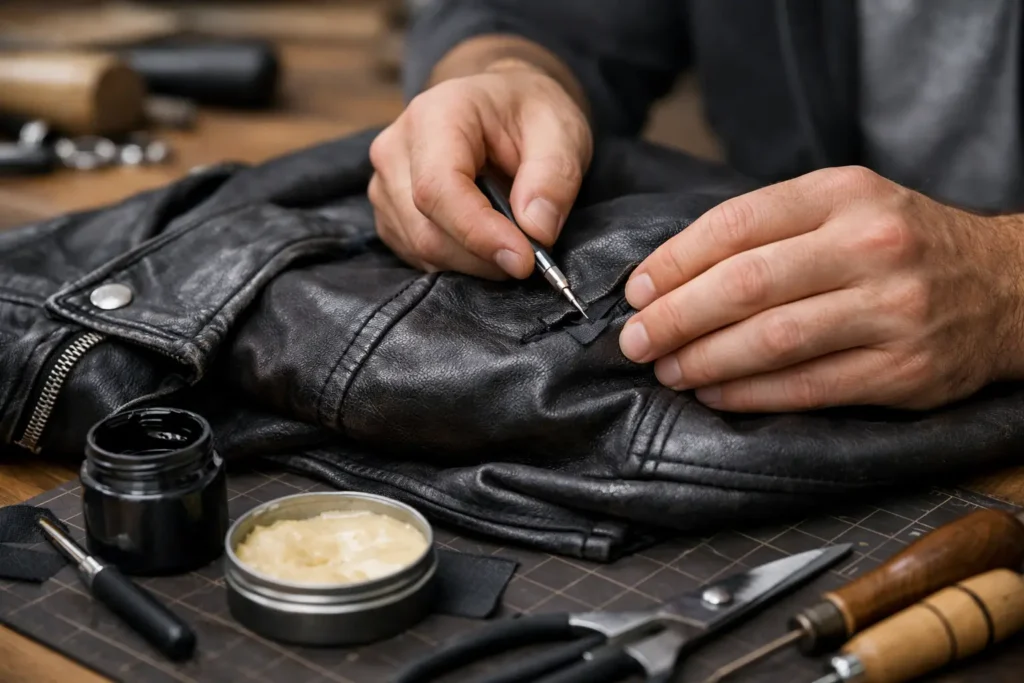
How to Repair a Leather Jacket Properly
A leather jacket earns its character through wear, but there is a clear line between a well-loved patina and damage that will keep spreading. When people search for “how to repair leather jacket” problems, the right answer depends on whether the issue is cosmetic, structural or hidden inside the garment. A small scuff may respond well to careful home care. A split seam, torn panel or damaged lining usually needs a tailor with experience handling leather.
Leather is not like denim or cotton. Every needle hole is permanent, heat can change its finish, and the wrong adhesive can leave a stiff, shiny patch. Taking a measured approach helps preserve the fit, feel and value of your jacket.
Start by identifying the leather and the damage
Before cleaning, gluing or sewing anything, inspect the jacket in natural light. Look at the location of the damage, how deep it is, and whether the surrounding leather feels dry, thin or stretched. A surface mark on a sturdy cowhide biker jacket needs different treatment from a tear in a soft lambskin fashion jacket.
Check the care label if it is still present. Genuine leather may be smooth, suede, nubuck, corrected-grain or finished with a protective coating. Suede and nubuck have a raised texture and should not be treated with standard leather creams or liquid repair products. If you are unsure what you have, avoid experimenting on the visible area.
It also helps to distinguish between a cracked finish and cracked leather. Sometimes the coloured top coating has worn away while the leather beneath remains sound. In other cases, the hide itself has become dry and split. The second problem is more serious because adding colour will not restore the leather’s strength.
How to repair leather jacket scuffs and light scratches
Minor scuffs are often the most realistic home repair. Begin by removing dust with a soft, dry cloth. For smooth leather, lightly wipe the affected area with a barely damp cloth, then allow it to dry naturally away from direct sun, heaters and hairdryers.
Once dry, apply a small amount of leather conditioner using a clean cloth. Work gently in small circles and use less than you think you need. Conditioner can soften the appearance of pale scuffs by nourishing dry leather, but it will not disguise a deep scratch where colour has been removed.
For a deeper colour loss, a leather repair cream or colour-matched balm may help. Test it on an inconspicuous inside edge first. Build up thin layers rather than applying one heavy coat, and allow each layer to dry fully. A close colour match matters more than trying to make the mark disappear completely. An overly dark or glossy patch is often more noticeable than a faint scar.
Do not use shoe polish, permanent marker, household oil or paint. These quick fixes can rub onto clothing, affect the finish and make professional restoration harder later.
When a scratch needs professional attention
A scratch deserves expert assessment if it has cut through the leather, has lifted edges, sits on a prominent panel, or runs close to a pocket, zip or seam. Matching colour and sheen across an older jacket can be difficult, particularly when the leather has faded naturally over time. A repairer can advise whether a local restoration will blend well or whether the panel needs reinforcement from behind.
Repairing loose stitching and split seams
Loose thread at a seam should be dealt with early. Do not pull it, as that can unravel more stitching. Trim only the loose end if it is clearly detached, then check whether the seam is opening when you gently move the jacket.
A seam that has come apart can sometimes be restitched, but leather requires the correct needle, thread, machine setting and technique. Standard domestic sewing can create a row of oversized holes or cause the leather to drag and pucker. The repair also needs to follow the original stitch line as closely as possible, because new holes beside old ones weaken the area.
Seams around the underarm, sleeve, side body and pocket opening carry regular tension. These are not good candidates for a quick hand-sewn repair. A professional leather alteration service can assess the seam allowance, reinforce the affected section where needed, and restitch it without changing the jacket’s shape.
If the leather itself has torn away from the stitching, the repair may need a backing patch inside the jacket before the seam is sewn. This is more durable than simply forcing the damaged edges back together.
Treat tears, holes and peeling leather with care
A clean, small tear may be repairable with a flexible leather adhesive and a thin backing piece placed behind the tear. However, this is delicate work. The adhesive must be suitable for leather, used sparingly, and kept away from the visible grain. Too much glue can soak through, harden the area or leave an edge that catches the light.
For larger holes, missing pieces or tears in high-stress areas, a patch is usually the practical answer. A patch can be placed inside for strength, outside as a visible design feature, or both. The trade-off is appearance: an invisible repair is not always possible, especially if the original leather is aged, distressed or an unusual colour.
Peeling is another case where expectations matter. If a jacket is bonded leather or has a synthetic coating over a backing material, widespread peeling may not be economically repairable. Spot treatment can improve small areas, but it cannot reliably restore a failing surface across the whole garment. An honest assessment can save you from spending money on a short-lived fix.
Do not overlook the lining, zip and hardware
A jacket can look fine from the outside but feel unwearable because of a torn lining, broken pocket bag or jammed zip. These repairs are often more straightforward than leather panel repairs, yet they require careful access through the lining and around the leather edges.
A torn lining can be patched or replaced in part, depending on its condition. If it is worn in several places, replacing a larger lining section can offer a cleaner and longer-lasting result. A tailor can also repair loose pocket linings, replace worn snaps and assess whether a zip slider can be repaired or if the full zip needs replacing.
Zips should not be forced. If the slider is catching, check for trapped lining fabric and gently clear it. If teeth are missing, bent or separated, stop wearing the jacket until it is assessed. Repeated tugging can tear the zip tape from the leather, turning a smaller repair into a more involved one.
Protect the repair and prevent new damage
After any repair, give the jacket a little care so the leather remains flexible. Condition smooth leather occasionally, particularly after winter wear or if it feels dry. How often depends on the climate, how frequently you wear it and the type of leather. Over-conditioning can leave residue, so a light application once or twice a year is often enough for many jackets.
Store your jacket on a broad, supportive hanger in a cool, dry wardrobe. Avoid plastic bags, which can trap moisture, and do not fold the jacket for long periods. Keep perfume, hairspray and alcohol-based cleaners away from the leather, as they can mark or dry the finish.
Rain is not always disastrous, but soaking leather needs patient drying. Blot moisture gently, reshape the jacket on a hanger and let it air dry at room temperature. Never place it on a radiator or in direct sunlight. Once it is completely dry, a small amount of suitable conditioner can restore suppleness.
When to bring your jacket to a leather repair specialist
Professional help is the sensible choice when the repair affects the fit, strength or visible finish of the jacket. This includes torn leather, damaged panels, broken zips, split underarm seams, extensive lining damage and alterations to sleeves, sides or length. These jobs need precision because leather cannot be unpicked and resewn repeatedly without leaving evidence.
At AD Stitch in Heidelberg, leather garments are assessed with the same care as a well-fitted suit or special-occasion dress. A close inspection makes it possible to discuss what can be repaired, what result is realistic, and whether reinforcing, patching or replacing a component offers the best value.
A quality leather jacket is worth treating as a long-term wardrobe piece. Repairing it early, before a scuff becomes a tear or a loose seam becomes a split panel, keeps it comfortable to wear and lets its character develop the right way.