


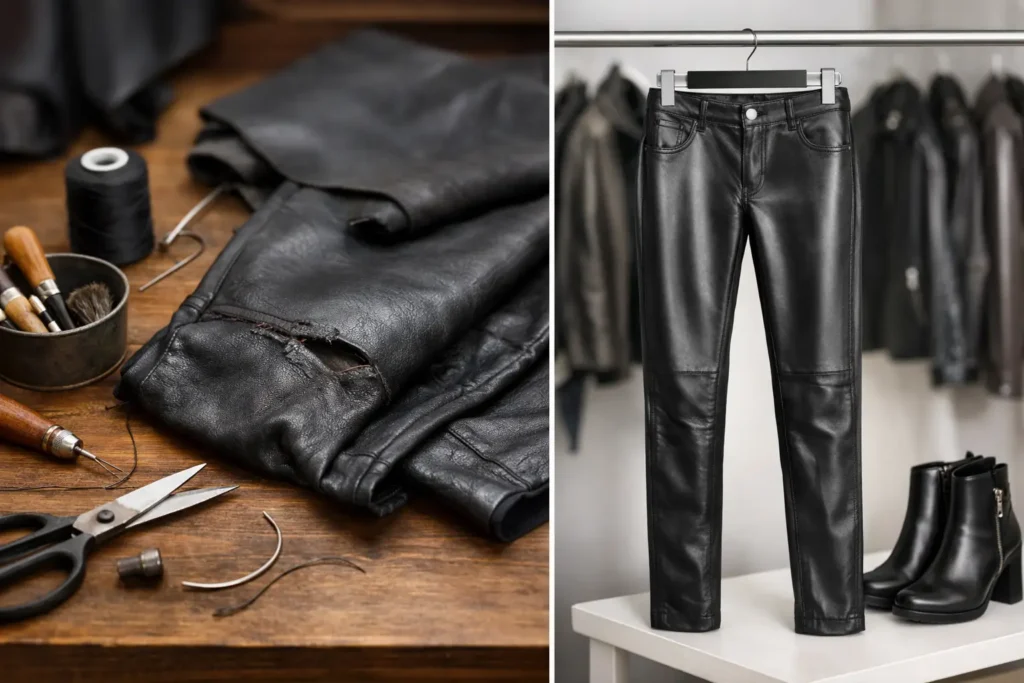
Repair or Replace Leather Pants?
A split seam at the seat, a torn knee, a zip that no longer closes properly – leather pants rarely fail quietly. When they do, the usual question is whether to repair or replace leather pants, and the answer depends less on the damage alone and more on fit, leather quality, construction and cost.
Leather is not like denim or standard woven fabric. It stretches differently, marks differently and needs a more careful hand when it is repaired or altered. A quick fix done poorly can leave visible needle holes, uneven panels or added stress in the wrong area. A proper assessment looks at the whole garment, not just the obvious fault.
How to decide whether to repair or replace leather pants
If your leather pants fit beautifully, the case for repair is often strong. A well-cut pair that sits properly through the waist, hips and leg is worth protecting, especially if the leather itself is still supple and the damage is localised. Many people underestimate how difficult it is to replace a pair that already suits their shape and style.
On the other hand, if the pants never fit quite right, have multiple weak points, or the leather has become dry and brittle, replacement may be the smarter choice. Repairing one problem on a garment that is failing in several places can become false economy.
A good tailor will usually assess five things at once: the condition of the leather, the position of the damage, the quality of the original make, the overall fit and the likely life left in the garment after repair. That broader view matters because the cheapest immediate option is not always the best value.
Damage that can often be repaired well
Some leather issues look dramatic but are very repairable in skilled hands. Split seams are one of the most common. If the leather panels themselves are sound and the stitching has simply given way under strain, resewing or reinforcing the seam can often restore both function and appearance.
Zip replacements are another worthwhile repair. If the body of the pants is still in good condition, a failed zip should not automatically send them to the back of the wardrobe. The same goes for broken hooks, loose waistbands and detached belt loops.
Tears can sometimes be repaired successfully too, but this is where technique and placement matter. A small tear in a less visible area may be strengthened and closed neatly. A tear across a high-stress point such as the crotch or inner thigh can still be repairable, but it needs more care and may require reinforcement to prevent the problem returning.
Lining repairs are often well worth doing. If the outer leather still looks good but the internal lining has worn through or twisted, replacing or repairing the lining can make the pants comfortable to wear again without changing their appearance.
Minor fit adjustments can also extend the life of leather pants. Waist reductions, tapering through the leg and some hem alterations are possible, although leather is less forgiving than cloth and every cut leaves a permanent trace. That is why precision matters.
When replacement is usually the better option
Sometimes the honest answer is to move on. If the leather surface is cracking across several areas, especially around flex points, the material may no longer have enough strength to hold a repair. Dry, stiff leather tends to keep breaking because the issue is in the hide itself, not just the stitching.
Severe peeling or surface breakdown is another warning sign. Once the finish is failing broadly, repairs may solve one local issue but leave the garment still looking tired overall. Likewise, if previous repairs have already perforated the leather with multiple stitch lines, there may not be enough clean structure left for another durable fix.
Fit also matters more than people think. If your leather pants are uncomfortable in the rise, too tight through the seat, or cut in a shape that no longer suits you, repair alone may not solve the bigger problem. You can put money into restoring a pair only to discover you still do not enjoy wearing them.
Then there is the quality question. Fast-fashion leather garments often use thinner skins, cheaper linings and lower-grade hardware. They can sometimes be repaired, but not always cost-effectively. A well-made pair generally rewards repair better than a cheaply made one.
Repair or replace leather pants based on value, not just price
People often compare repair cost with the price of buying another pair, but that is only half the picture. The real comparison is repair cost versus replacement value.
If you own premium leather pants with quality construction, a good fit and a style you still wear, repair can offer excellent value. Replacing that same standard today may cost far more than expected, and a new pair may still need alterations for comfort and balance.
If the pants were inexpensive to begin with and have several issues at once, replacement may make better financial sense. Even then, there is a practical middle ground. Some customers choose a limited repair to get more wear from the garment for one more season rather than investing in a full restoration.
This is where an experienced alterations specialist is useful. You want a realistic opinion, not pressure in either direction. A trustworthy tailor should be able to explain what can be done, how visible the repair may be, and whether the garment is worth the work.
Why leather repairs need specialist handling
Leather keeps a memory of every needle hole. Unlike standard fabric, it does not simply recover once unpicked and redone. That means inaccurate stitching, poor tension or rough handling can leave permanent signs. It also means alterations need to be planned carefully before the first stitch goes in.
Matching thread, preserving seam lines and managing bulk are all part of the job. So is understanding how the pants were originally assembled. Some leather garments have topstitching that is central to their look. Others rely on hidden structure and clean shaping. Each approach needs a different repair strategy.
There is also the wearability factor. Leather pants need to move with the body. A repair that looks acceptable on a hanger but pulls or puckers when worn is not a good repair. Craftsmanship is not just about making damage disappear. It is about restoring confidence in the garment.
A practical way to assess your pair at home
Before you decide to repair or replace leather pants, lay them flat and check them closely in natural light. Look at the damaged area, then keep going. Are there cracks around the pockets, crotch, knees or hems? Is the lining intact? Does the zip run smoothly? Does the leather still feel supple, or is it starting to dry out and stiffen?
Next, think about how often you actually wear them. If they are a favourite piece that works with half your wardrobe, repair has more value. If they have sat unworn for years because the fit is off or the style no longer feels like you, replacement may be the more sensible call.
Finally, be honest about expectations. Some repairs can be almost invisible. Others are about strength and wearability rather than perfection. The best result is not always making a garment look brand new. Sometimes it is making it reliable, comfortable and presentable again.
For Melbourne customers, having leather pants assessed in person is usually the clearest next step. A specialist can feel the leather, inspect stress points and tell you whether a repair is likely to hold. At AD Stitch, that kind of practical guidance matters because the right result is not simply more work done – it is helping you spend wisely on clothes you will actually keep wearing.
Leather pants ask for a bit more judgement than most garments, but they are often worth that effort. If the leather is sound and the fit is right, repair can give a great pair a second life. If the material is failing or the garment no longer works for you, replacing them can be the cleaner choice. The most useful decision is the one that leaves you with something comfortable, wearable and worth reaching for again.