


How to Alter Suit Sleeves Properly
A suit jacket can fit beautifully through the shoulders and chest, then still look wrong because the sleeves are off by a centimetre or two. It is often the first thing people notice without realising why. If you are wondering how to alter suit sleeves, the answer depends on where the adjustment is made, how the cuff is constructed, and how much change the jacket actually needs.
Sleeve alterations sit in that category of tailoring that looks simple from the outside but needs careful handling. A clean result is not just about making the sleeve shorter. It is about keeping the balance of the jacket, the pitch of the sleeve, the button placement, and the proportion of shirt cuff showing all working together.
How to alter suit sleeves without spoiling the jacket
The first question is not how, but where. Suit sleeves can usually be altered from the cuff or from the shoulder, and those are two very different jobs.
Shortening from the cuff is the more common alteration. It is suitable when the jacket has enough room to lose length without interfering with the buttons, vents, or working buttonholes. This is often the most efficient and cost-effective option, and on many modern suit jackets it delivers an excellent result.
Altering from the shoulder is more complex. A tailor may choose this method when the sleeve has functioning buttonholes at the cuff, when the vent detail must stay untouched, or when the sleeve needs more than a simple length adjustment. It involves removing the sleeve, reshaping the armhole area, and setting everything back in correctly. That is skilled tailoring work, not a quick clothing repair.
There is also sleeve tapering, which changes the width rather than the length. If a sleeve looks too full through the forearm or wrist, it can often be slimmed for a neater line. The trick is to reduce bulk without making movement uncomfortable. A sleeve that looks sharp while your arms are at your sides but pulls the moment you bend your elbow is not a good alteration.
What a tailor checks before changing suit sleeves
Before any pinning happens, a good tailor looks at the whole jacket. Sleeve length does not exist in isolation.
The ideal finish depends on your height, arm length, shirt sleeve length, and how you wear the suit. A business suit usually looks best with a small amount of shirt cuff visible. Too much can look borrowed or dated. Too little can make the jacket appear long and heavy through the arm.
The construction of the jacket matters just as much. Some suit sleeves have decorative buttons only. Others have working buttonholes, sometimes called surgeon’s cuffs. Working cuffs limit what can be done from the hem because cutting and re-finishing the end of the sleeve may destroy the original detail. In that case, the alteration may need to be done from the top of the sleeve instead.
The lining, shoulder padding, sleeve pitch, and stripe or check matching also affect the job. If the cloth has a strong pattern, even a simple adjustment needs extra attention so the sleeve still looks consistent with the rest of the jacket.
This is why sleeve alterations are always worth assessing in person. Two jackets that look similar on the hanger can require very different methods once you inspect the make.
Shortening suit sleeves from the cuff
This is the alteration most people mean when they ask how to alter suit sleeves. The process sounds straightforward, but accuracy matters.
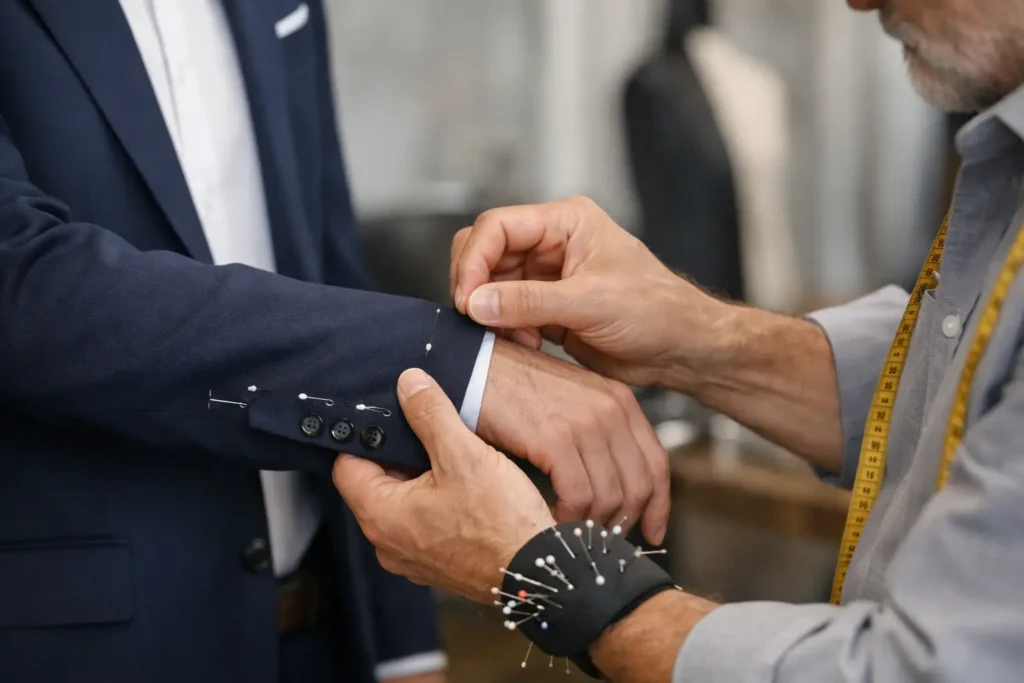
A tailor marks the new sleeve length while the jacket is worn properly, ideally with the shirt you intend to wear underneath. The cuff is opened, the sleeve length is reduced, and the lining is adjusted to match. Then the hem is rebuilt so it sits smoothly and cleanly.
If there are buttons on the cuff, they may need to be removed and reattached in the correct position. If the change is minor, this can usually be done without affecting the overall appearance. If the change is larger, the spacing can start to look awkward, which is one reason some jackets are better altered from the shoulder.
One important limit is that you cannot always shorten endlessly from the cuff. Once you get too close to buttonholes or vents, the proportions stop working. Good tailoring is not just asking whether something can be done. It is asking whether it should be done.
Altering suit sleeves from the shoulder
This is the more advanced route and usually the right answer for high-quality jackets with functional cuffs or complex finishing.
The sleeve is removed at the armhole, shortened from the top, and then reset into the jacket. That sounds simple in one sentence, but it requires experience to preserve the shape of the sleeve head and maintain a smooth drape from shoulder to wrist. Any inaccuracy here can create twisting, puckering, or drag lines that are hard to ignore.
There are times when this method gives the best result even though it is more involved. If the cuff detail is a feature worth preserving, or the amount being shortened would throw off the button placement, shoulder alteration is often the cleaner solution. It costs more because it is more labour intensive, but on a well-made suit it can be the right investment.
Can suit sleeves be lengthened?
Sometimes, yes. It depends on whether there is enough inlay, which is the extra fabric hidden inside the sleeve hem.
Many jackets have a small amount of cloth that allows for minor lengthening. Usually this is limited. If you need only a subtle extension, it may be possible. If you need a substantial change, the result may not be viable, especially if the original crease lines, wear marks, or cuff details would be exposed.
This is another area where expectations need to be realistic. Shortening is generally more flexible than lengthening. A tailor can tell you quickly whether there is enough allowance to work with.
When sleeve tapering makes more difference than sleeve length
Not every sleeve problem is a length problem. Some jackets are simply too wide through the sleeve, especially older suits or off-the-rack pieces designed for a broader fit.
Tapering refines the shape from the upper arm down to the cuff or through the forearm only, depending on where the excess cloth sits. Done well, it sharpens the jacket without making it look tight. Done poorly, it can distort the line of the sleeve or make the arm feel restricted.
The best taper keeps comfort in mind. You should still be able to drive, type, reach, and move naturally. Suit tailoring should improve ease as well as appearance.
What you should not try at home
Basic hemming on casual clothing is one thing. Altering a structured suit sleeve is another.
Suit jackets have layered construction, shaped seams, lining, interfacing, and often delicate cloth that shows every needle mark. Even measuring sleeve length can go wrong if the wearer stands awkwardly or the jacket is not sitting correctly through the shoulders. Once fabric is cut, there is rarely a simple way back.
Home fixes also tend to miss the finer details. Buttons end up uneven, lining pulls, the cuff rolls badly, or one sleeve finishes slightly shorter than the other. On a suit, those mistakes are obvious.
If the jacket matters to you, professional tailoring is the safer path. That is especially true for workwear, wedding suits, formal jackets, and anything with premium fabric or functioning cuffs.
How to know if your suit sleeves need altering
A quick mirror check usually tells the story. If your jacket sleeves cover most of your shirt cuff, bunch heavily at the wrist, or make your arms look shorter than they are, they are probably too long. If they sit high enough to expose too much shirt, they may be too short.
Width is just as telling. If the sleeve balloons through the forearm, twists oddly, or looks bulky compared with the rest of the jacket, tapering may help. If one sleeve hangs differently from the other, the issue may be pitch or balance rather than simple length.
The best fitting is done while wearing the shirt you would normally pair with the suit. Shoes also help, because posture changes when you are dressed properly rather than standing in socks on a fitting room floor.
Choosing the right tailor for suit sleeve alterations
Not all alteration services handle suits with the same level of care. Sleeve work requires more than a sewing machine and a quick turnaround promise.
Look for a tailor who understands jacket construction and can explain the options clearly. You want honest advice about what can be altered from the cuff, when the shoulder is the better approach, and whether the change is worth doing at all. The best result often comes from measured restraint, not from forcing an alteration that will compromise the garment.
For Melbourne clients bringing in business suits, event wear, or a favourite jacket that needs refining, an experienced local tailor can assess the sleeve length, width, and cuff construction in a few minutes and recommend the cleanest solution. At AD Stitch, that kind of practical, craftsmanship-led advice is part of getting the fit right the first time.
A well-altered sleeve does not call attention to itself. It simply makes the whole jacket look more expensive, more comfortable, and more like it was made for you.