


How Do I Get a Suit Altered to Fit Perfectly?
A suit can be expensive, but the real difference between looking properly dressed and merely dressed often comes down to fit. If you have ever asked, how do I get a suit altered to fit perfectly, the good news is that you usually do not need a brand-new suit. You need a skilled tailor, a clear fitting process, and a realistic understanding of what can and cannot be improved.
A well-altered suit should feel comfortable when you sit, stand and move, while still looking clean through the shoulders, chest, waist and legs. It should not pull, bunch or hang heavily in the wrong places. Good tailoring does not make a suit look altered. It makes it look like it was made for you.
How do I get a suit altered to fit perfectly?
Start by bringing the full outfit to your fitting, not just the jacket or trousers on their own. Wear the shirt you would normally pair with the suit, along with your usual dress shoes and belt if you wear one. Small details change the final proportions. Trouser length, jacket balance and sleeve position all look different depending on what you wear underneath and on your feet.
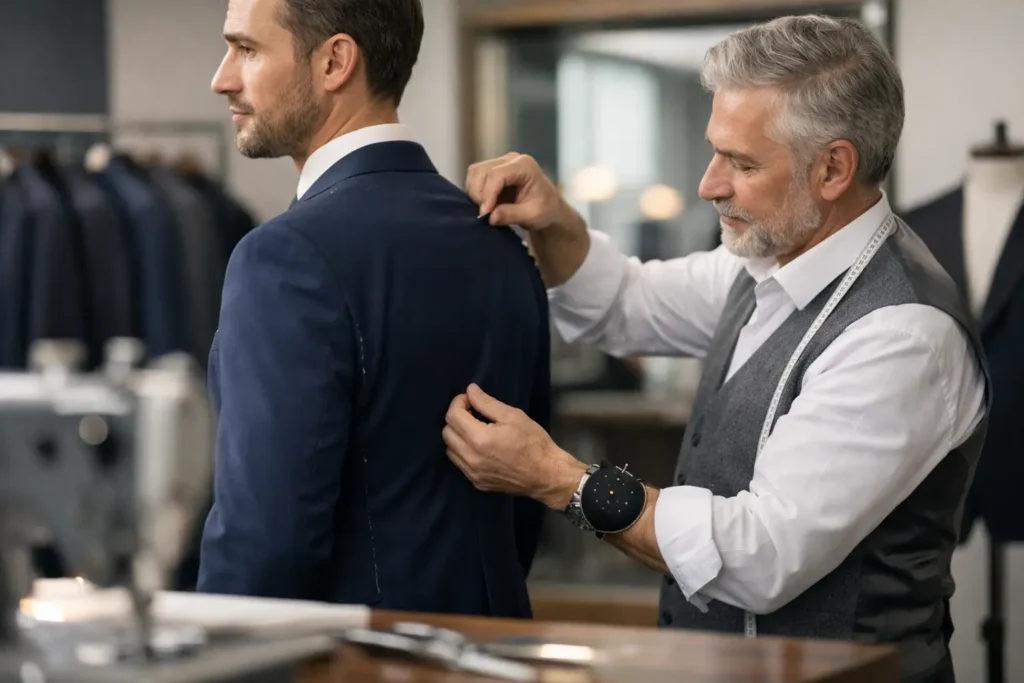
When you arrive for a fitting, expect the tailor to assess the suit on your body rather than on a hanger. This matters because a suit can look acceptable when laid flat and still sit poorly once worn. A trained eye will look at how the jacket sits on your shoulders, whether the collar stays close to the neck, how the waist shapes your frame, and whether the trousers break neatly over the shoe.
The best approach is to tell your tailor how you want the suit to feel and where you think the problems are, then listen to their advice on what is structurally possible. Some customers want a close, modern fit. Others need more room for comfort, workwear practicality or long event days. There is no single perfect fit for every person. The right fit is the one that suits your body, the garment, and how you plan to wear it.
What parts of a suit are usually altered?
Most suit alterations focus on refinement rather than reinvention. Jackets can often be taken in through the sides to reduce excess fullness at the waist. Sleeves can usually be shortened or lengthened within the available seam allowance. Trousers are commonly hemmed, tapered through the leg, taken in or let out at the waist, and adjusted through the seat if the shape allows.
These are the changes that usually deliver the biggest visual improvement. A jacket waist adjustment can sharpen your shape immediately. Trouser hemming can make the whole suit look more polished. Sleeve length can show the right amount of shirt cuff and tidy the overall line.
Some changes are more complex. Adjusting shoulders, recutting the chest, or correcting a badly imbalanced jacket can be possible, but they require more labour, more skill and sometimes more cost than the garment justifies. That does not mean the suit is hopeless. It means the tailor needs to judge whether the result will be worth it.
The shoulder is the starting point
If you are buying a suit to alter, get the shoulders as close as possible from the start. The shoulder line affects everything else. If it is too wide, too narrow, or collapsing oddly at the sleeve head, there are limits to how cleanly that can be fixed.
This is why experienced tailors often say to buy for the shoulders first, then alter the rest. The waist, sleeves and trousers are usually more forgiving. The shoulder is where a suit either begins well or fights you the whole way.
Trousers matter more than people think
Many people focus on the jacket and forget that poorly fitting trousers can spoil the whole look. If they are too long, they bunch at the ankle. If they are too tight through the seat or thigh, they pull and crease in a way that looks uncomfortable because it is uncomfortable.
A proper trouser alteration should balance comfort with a clean line. You want enough room to sit and move, but not so much fabric that the leg looks heavy. The right break over the shoe also depends on the style of the suit and your preference. Some people prefer a slight break, while others want a more cropped, contemporary finish.
What to expect at a suit fitting
A good fitting is practical and specific. You will usually try on the jacket and trousers while the tailor pins key areas. They may ask you to stand naturally, walk a little, sit down, and raise your arms. This is not fussiness. A suit that only looks good when you stand perfectly still is not fitted properly.
You should also expect honest advice. Sometimes a customer asks for the slimmest possible fit, but the cloth, cut or body shape does not support it. Taking a suit in too aggressively can cause strain lines, pockets that flare, and seams that sit under constant pressure. Better tailoring respects the garment as well as the person wearing it.
If the suit is for a wedding, job interview, corporate wear or a special event, say so. Occasion matters. A wedding suit may be fitted a little sharper. A work suit often needs more all-day comfort. A suit worn a few times a year can tolerate different choices from one worn every week.
How to know if your suit fits properly
A well-fitting jacket should sit neatly on the shoulders without dipping or overhanging. The collar should stay close to the shirt collar instead of gaping at the back of the neck. When buttoned, the jacket should shape the torso without pulling across the front.
Sleeves should finish neatly above the wrist bone, usually allowing a little shirt cuff to show. The jacket length should look balanced on your frame, covering the seat appropriately without making your legs look short.
Trousers should sit comfortably at the waist without needing constant adjustment. The seat should be smooth, not tight and not saggy. Through the leg, the fabric should fall cleanly. At the hem, the break should look intentional rather than accidental.
These points sound simple, but together they create the overall effect people notice. Most onlookers cannot name the technical details. They just see that the suit looks right.
Common mistakes when getting a suit altered
One common mistake is buying a suit that is far too big and assuming tailoring can solve everything. Extra fabric can be reduced in some areas, but not every proportion can be rebuilt successfully. Another is rushing the process right before an event. Quality alterations take planning, and some suits need more than one fitting.
It is also a mistake to judge fit purely by trends. A very slim suit might look current for a moment, but if it restricts movement or creates visible pulling, it is not a good fit. Likewise, going too roomy in the name of comfort can make an otherwise nice suit look borrowed.
The final mistake is choosing alterations based on price alone. A suit is a structured garment. It needs technical handling, careful pinning and accurate finishing. Cheap, rushed work often shows in twisted sleeves, uneven hems, puckered seams or a jacket that no longer hangs correctly.
How do I get a suit altered to fit perfectly without overdoing it?
Think in terms of balance, not perfection in the abstract. The goal is not to remove every crease or make the suit skin-tight. The goal is to make the suit sit cleanly on your body, move well, and feel comfortable enough that you can forget about it once you put it on.
That usually means prioritising the changes with the biggest impact. Sleeve length, jacket waist suppression, trouser hem and waist adjustment often give excellent results without unnecessary complexity. If a more major structural change is needed, ask whether it is worthwhile for that particular suit.
For Melbourne customers who want that mix of honest advice, precision and personal service, working with an experienced local tailor makes the process much easier. The right tailor will explain what can be improved, what should be left alone, and how to get the best result from the suit you already own.
A suit should never feel like a costume or a compromise. When the fit is right, you stand better, move more comfortably and look more confident without trying too hard.