


Can Curtains Be Taken Up? A Tailor’s Guide
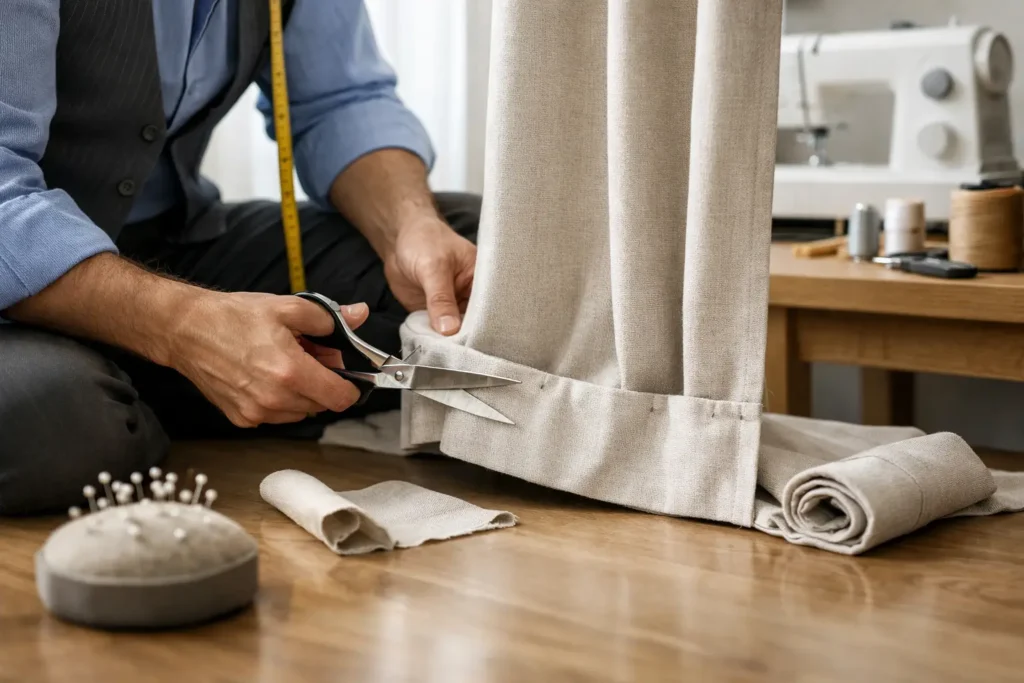
Curtains that puddle on the floor can make an otherwise tidy room feel unfinished. They collect dust, get caught under furniture and may fade or wear along the bottom edge. So, can curtains be taken up? In most cases, yes. Shortening curtains is a practical alteration that can improve their appearance, protect the fabric and help them sit properly in the room.
The best method depends on the curtain style, fabric, lining and heading. A simple unlined panel is very different from a lined blockout curtain, a sheer, or a set of pinch-pleat drapes. Careful measuring and a well-finished hem make the difference between curtains that look custom-fitted and curtains that look obviously shortened.
Can curtains be taken up without affecting the look?
Yes, provided the amount removed and the construction of the curtain are considered first. Curtains are generally taken up from the bottom, preserving the heading at the top. This keeps eyelets, tabs, pleats, hooks and header tape in their original position, so the curtain continues to hang as intended.
The key is maintaining the correct hem depth. A quality curtain hem has enough fabric turned under to create a clean, weighted edge. If too much length is removed without allowing for that turn-up, the hem can become narrow, stiff or prone to pulling. On sheer fabrics, an uneven or bulky hem is especially noticeable when light comes through the window.
A professional alteration also accounts for the curtain’s natural fall. Some fabrics relax after hanging, while others can draw up slightly after cleaning. Heavier fabrics may need a deeper hem or discreet curtain weights to hang straight. These small details are what give finished curtains a balanced, tailored appearance.
Start with the right finished length
Before any cutting or stitching begins, decide where the curtains should finish. There is no single correct answer. It comes down to the room, the fabric and the look you prefer.
For a crisp, practical finish, curtains usually sit around 10 to 15 mm above the floor. This works well in busy rooms and homes where curtains are opened and closed regularly. It avoids dragging while still looking intentional.
A curtain that just kisses the floor can create a softer, more luxurious look, but it requires accurate measuring. Even a small difference in floor level can make one side appear longer. A slight puddle of fabric is a decorative choice often used with formal drapes, though it is less practical near doors, pets, children or high-traffic areas.
Measure after the curtain rod or track has been installed and the curtains are hanging. Measure from the point where the curtain is supported, such as the underside of a ring or the top of a hook, down to the desired finished point. Take several measurements across the width because floors, tracks and curtain rods are not always perfectly level.
Which curtains are easiest to shorten?
Unlined curtains with a plain bottom hem are generally the most straightforward. Cotton, linen-look fabrics, polyester and many standard curtain materials can be shortened neatly with a machine-stitched or hand-finished hem.
Sheers can also be taken up, but they need a lighter touch. Their fabric is fine, slippery and often transparent, so the stitching, thread colour and hem width must be chosen carefully. A narrow rolled hem may suit some sheers, while others need the original hem replicated as closely as possible.
Lined curtains take more time because the face fabric and lining need to be altered separately and then finished so they hang together smoothly. Blockout curtains can be more complex again. Depending on how they are made, cutting the fabric incorrectly may expose the coating or compromise the light-blocking finish at the hem.
Curtains with borders, contrasting trim, patterned hems, scalloped edges or decorative bands need individual assessment. Taking them up from the bottom can remove a feature that is central to their design. In some cases, the better option is to alter the top heading or reposition a trim, but that is more specialised work and may not be worthwhile for every curtain.
How much can curtains be taken up?
Most curtains can be shortened by a small amount or by a substantial amount, as long as there is enough fabric for a proper new hem. The more length removed, the more important it becomes to check the balance of the design.
For example, a floral print may still look right after a 50 mm adjustment, but removing 300 mm could place an awkward section of the pattern at the bottom. Stripes can reveal even the slightest crooked hem. With lined curtains, a large reduction may also change how the lining sits behind the face fabric.
If the curtains have been sitting on the floor for years, inspect the bottom edge before deciding. Sun damage, fading, fraying and dust marks can often be removed as part of the alteration. This can refresh curtains that are otherwise in good condition and extend their useful life.
Why DIY curtain hemming can be tricky
Iron-on hemming tape may seem like a quick fix, particularly for lightweight ready-made curtains. It can be suitable as a temporary solution, but it has limits. Adhesive tape may release over time, especially with heat, humidity, frequent washing or a heavy fabric pulling against it. It can also leave a stiff edge that does not drape naturally.
Sewing curtains at home is certainly possible if you have the right machine, thread and space to work. The challenge is handling the volume of fabric while keeping the hem level across a wide panel. A dining table is rarely wide enough for full-length curtains, and letting fabric pull as it feeds through the machine can create a wavy hem.
Lined and blockout curtains introduce further risks. A needle that is too large can leave visible holes, while an unsuitable stitch or tension can pucker the fabric. Once a curtain has been cut too short, there is usually no simple way to put the length back.
What to bring when having curtains altered
Bring all curtain panels together, including any matching lining panels or tiebacks. If possible, bring a clear measurement of the desired finished drop and explain whether you want the curtain above the floor, touching it or pooling slightly.
Photos of the curtains hanging in place can be helpful, especially where the floor slopes, furniture sits close to the window or the curtains need to clear a heater. If one panel has already been measured or pinned, bring the matching panel as well. Curtains should be assessed as a pair so their finished lengths match.
At AD Stitch, curtain alterations are approached with the same care as a well-fitted garment. The fabric, construction and final look all matter, because a clean hem helps the entire room feel more considered.
A better fit for the room
Taking up curtains is often a simple alteration with a noticeable result. The right finished length keeps fabric clean, improves the way it hangs and makes ready-made curtains look far more at home in your space.
If the curtains are lined, delicate, patterned or expensive, it is worth having them measured and finished properly rather than risking an uneven cut. A precise hem is a small detail, but it is one you will see every time the curtains are drawn.