


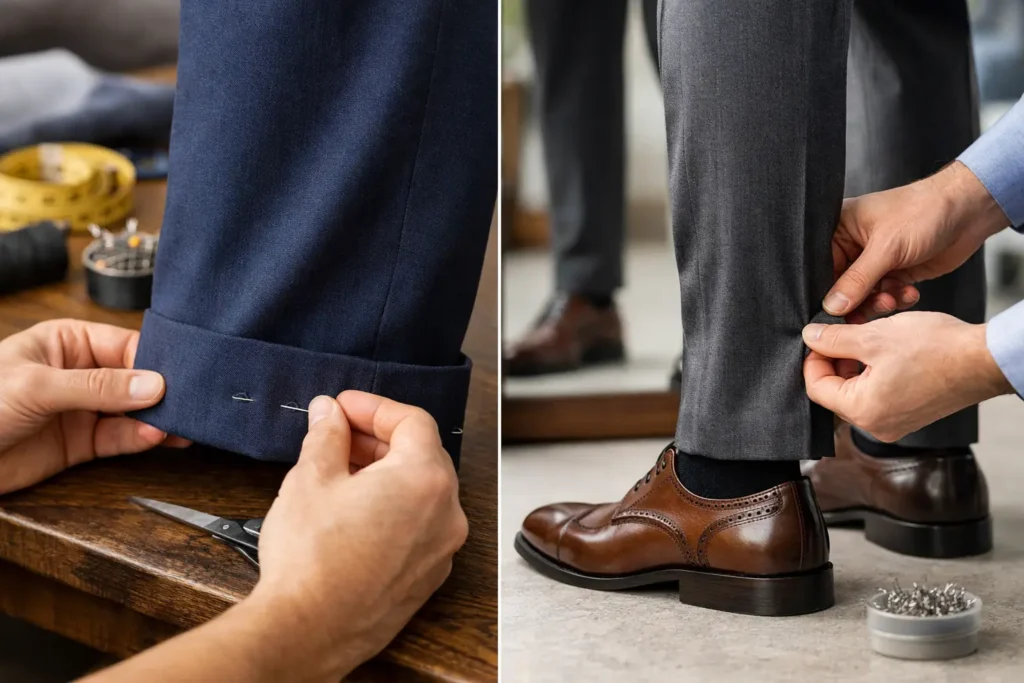
Hemming vs Tapering Trousers Explained
A pair of trousers can be the right size on the label and still sit poorly on the body. Maybe the break is too heavy over your shoes, or the leg feels wide and shapeless from the knee down. That is where hemming vs tapering trousers becomes a useful question, because these two alterations solve different fit problems and give very different results.
Many customers use the terms interchangeably, but a hem and a taper are not the same job. One changes the length. The other changes the width and line of the leg. If you know which issue you are trying to fix, you are far more likely to get a result that looks balanced, feels comfortable, and suits the way you actually wear the garment.
Hemming vs tapering trousers: what is the difference?
Hemming trousers means shortening or, in some cases, lengthening the leg at the bottom. The tailor adjusts where the trouser finishes on your shoe or ankle, while keeping the overall shape of the leg much the same. If your trousers bunch up at the bottom, drag on the ground, or create too much fabric break, hemming is usually the answer.
Tapering trousers means narrowing the leg to create a slimmer line. This is done by taking fabric in along the inner seam, outer seam, or both, depending on the construction and the result required. Tapering does not primarily change the length. It changes the silhouette.
This distinction matters because the wrong alteration can leave you with trousers that are technically altered but still not flattering. Shortening a wide trouser leg will not make it look sharper. Tapering a trouser that is simply too long will not fix the stack of fabric sitting over your shoe.
When hemming is the right alteration
Hemming is the right choice when the trousers fit well through the waist, seat, and leg, but the length is off. This is one of the most common adjustments because off-the-rack trousers are made for broad size ranges, not your exact height or preferred trouser break.
For business trousers and suit pants, the goal is usually a clean finish with a slight break or no break, depending on personal style. Too long, and the trousers look messy and heavier than they should. Too short, and they can look awkwardly cropped unless that is the intended style.
For casual trousers and chinos, the ideal length depends on the shoe and how fitted the leg already is. A slimmer leg often works well slightly shorter. A fuller leg usually needs a bit more length to hang properly. Jeans are another category again, especially if you want to preserve the original hem.
Good hemming is not just about taking fabric off the bottom. A tailor also considers the shoe height, whether you wear the trousers high or low on the waist, and whether the back hem should sit slightly longer than the front. These details are what make the finished length look natural rather than simply shorter.
Signs your trousers need hemming
If you notice deep folds pooling at the ankle, the hem catching under your heel, or the front of the trouser collapsing over the vamp of the shoe, the length is likely too long. If the sock is constantly exposed when standing still, the length may be too short.
The best length is not always the same from one trouser to the next. Dress trousers, linen trousers, wide-leg styles, school pants, and tailored wool trousers all behave differently. Fabric weight and drape affect where the hem should finish.
When tapering is the better option
Tapering is for trousers that feel too wide through the leg. Perhaps they fit well at the waist and hips, but below the thigh they lose shape. This is particularly common with older trousers, relaxed cuts, or garments bought to fit one area of the body first and altered later.
A taper can make trousers look neater, more modern, and better balanced with your frame. It can also improve comfort in a practical way by reducing excess fabric that twists, flaps, or catches around the ankle.
That said, tapering has to be done with restraint. If the leg is narrowed too aggressively, the trousers can pull across the calf, distort the crease, or sit awkwardly over the shoe. A clean fit should follow the body without clinging to it.
Signs your trousers need tapering
If the leg looks boxy, the fabric swings out at the sides, or the ankle opening feels disproportionately wide compared with the rest of the trouser, tapering may help. You might also notice that the trouser looks fine when standing still but loses shape as soon as you walk.
Not every trouser should be slimmed. Pleated trousers, formal cuts, and some relaxed styles are designed to drape with more volume. Forcing a narrow taper onto a garment that was cut to fall softly can make it look unbalanced. This is where experienced tailoring advice really counts.
Can you hem and taper trousers at the same time?
Often, yes. In fact, many trousers look best when both alterations are considered together.
If you shorten trousers significantly, the leg opening can appear wider than it did before, simply because you have moved the hem to a higher point on the leg. In that case, hemming alone may leave the trousers looking short and broad. A light taper can restore proportion.
The reverse is also true. If you taper trousers without checking the length, the narrower hem may sit differently over the shoe and reveal that the trousers are now too long or too short for the new shape. Looking at both alterations together leads to a more polished result.
This is especially relevant for suit trousers, chinos, and smart casual pants where overall balance matters. A good tailor will assess the full line of the garment rather than treating each alteration as an isolated task.
Hemming vs tapering trousers for different styles
Suit trousers usually need a conservative approach. Hem length affects how the crease falls, while tapering must respect the original line of the suit. Too much narrowing can make the trousers look disconnected from the jacket.
Chinos are more flexible. A hem can clean up bunching at the shoe, and a moderate taper often sharpens the whole look without making the trousers feel overly formal.
Jeans require extra care because denim is heavier, and many people want to preserve the original finish at the hem. Tapering jeans can also affect how they stack and sit over boots or sneakers, so the intended footwear matters.
Women’s trousers vary even more. Wide-leg trousers, straight-leg work pants, cropped styles, and event wear all call for different decisions. What works on a slim ankle pant will not suit a flowing formal trouser.
What a tailor considers before altering trousers
A proper fitting does more than identify whether the trousers are too long or too wide. The tailor looks at body shape, fabric behaviour, seam allowance, pocket position, crease alignment, and how the garment is meant to be worn.
For example, tapering can be limited by pocket placement, zip openings, pattern matching, or the amount of fabric available in the seams. Hemming can also be limited if there is not enough fabric to lengthen the trouser, or if the original finish is complex.
There is also the question of proportion. A narrow hem opening can look sharp on one person and too tight on another. Likewise, the ideal trouser length changes depending on whether you wear loafers, heels, work boots, or flat sneakers.
This is why pinning a pair of trousers at home can only tell you so much. The final result depends on how the garment hangs from the waist all the way down.
Getting the best result from trouser alterations
Bring the shoes you expect to wear most often with the trousers, especially for dress pants or event wear. Small differences in heel height can change the hem more than people realise.
Be clear about how you want the trousers to feel, not just how you want them to look. Some customers want a cleaner silhouette but still need room through the calf for movement. Others prefer a classic drape rather than a close fit. Those details help the tailor adjust the garment to your lifestyle, not just a mannequin ideal.
If you are unsure, ask for the most balanced option rather than the most fashion-forward one. Trends move quickly. Well-proportioned trousers last.
At AD Stitch, this is often where the value of expert clothing alterations becomes obvious. A careful fitting can identify whether your trousers need a simple hem, a full taper, or a combination that improves the whole line of the garment.
The most useful way to think about hemming vs tapering trousers is this: hemming fixes where the trousers end, while tapering fixes how they fall. Once those two elements are working together, the entire garment tends to look more expensive, feel more comfortable, and earn its place in your wardrobe again.